Library-level depth

Scholarship,organized fordiscovery.

Search the complete record by title, author, citation, year or keyword. Filter by publication type and year without changing how scholarship is entered or managed in WordPress.

50works shown
2026 Book

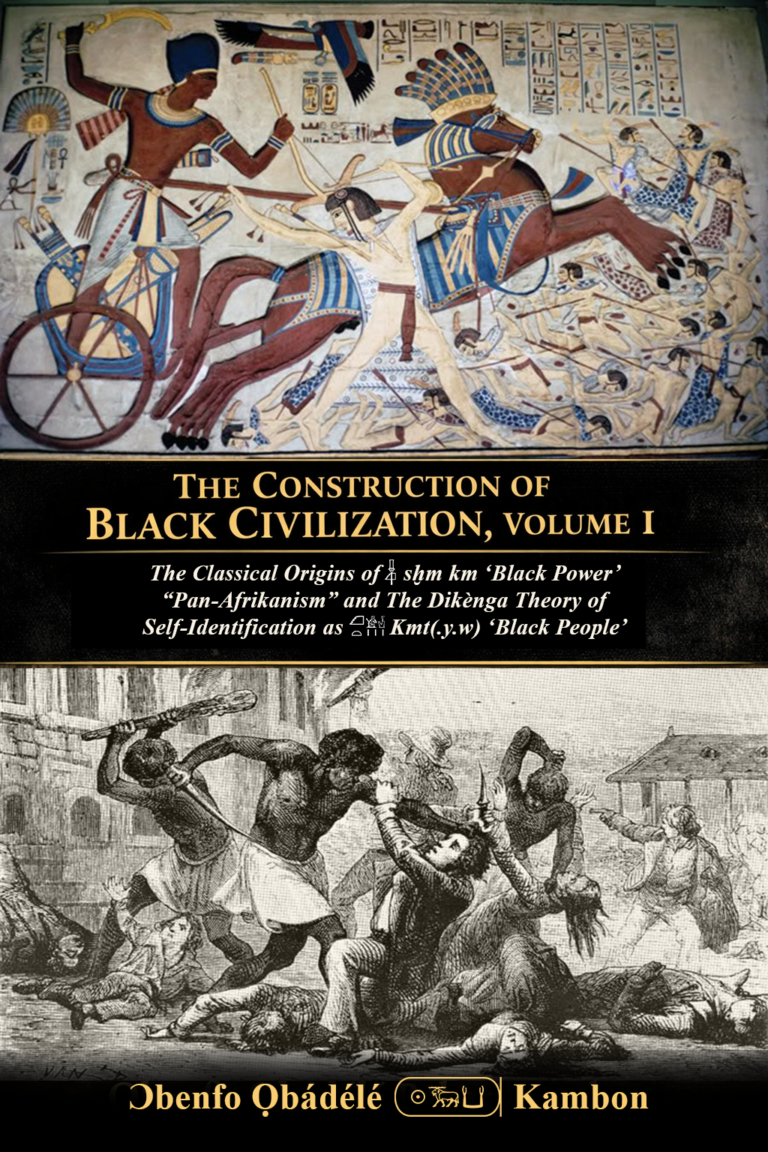
The Construction of Black Civilization Volume I: The Classical Kmt(.y.w) ‘Black People’ Origins of sxm km ‘Black Power’ “Pan-Afrikanism” And The Dikènga Theory of Self-Identification As Kmt(.y.w) ‘Black People’ (Vol. I).

Ọbádélé Kambon

Kambon, Ọ., (2026). The Construction of Black Civilization Volume I: The Classical Kmt(.y.w) ‘Black People’ Origins of sxm km ‘Black Power’ “Pan-Afrikanism” And The Dikènga Theory of Self-Identification As Kmt(.y.w) ‘Black People’ (Vol. I). BlackNificent Books/Afrikan World Books. (In press)

Full record ↗
Abstract, significance and citation data

Pre-orders now available exclusively on Abibitumi.com: https://www.abibitumi.com/construction The Construction of Black Civilization (Volume I) The Classical Origins of sḫm Km ‘Black Power’ “Pan-Afrikanism” and The Dikènga Theory of Self-Identification as Kmt(.y.w) ‘Black People’ What if “Pan-Afrikanism” didn’t begin in the modern era—but in classical Kmt, as a conscious project of Kmtyw ‘Black People’ building power for collective survival? In this sweeping, source-driven Volume I, Ɔbenfo (Professor) Ọbádélé Bakari Kambon demonstrates that sxm km ‘Black Power’ “Pan-Afrikanism” is an ancient imperative rooted in Kmt ‘The Black Nation/Land of the Blacks’. Through meticulous readings of primary texts and a clear evaluative framework—the 3Rs (Relate, Relative, Relevant) and twelve criteria for textual analysis—Kambon shows how Kmtyw self-identified as Black, organized internally, allied with…
“You Can Sit Down Next to White Folks – On the Toilet”: Segregation, Apartheid, and Untouchability

Ọbádélé Bakari Kambon & Lwanga Songsore

“You Can Sit Down Next To White Folks – On The Toilet” – Integration, Apartheid, And Untouchability. African Journal of Media & Society, 1(1).

Full record ↗ Download
Abstract, significance and citation data

In this paper, we wish to demonstrate—by means of a tri-continental analysis—the fact that Abibifoɔ ‘Black People’1 the world over are subject to genocide at the hands of eurasians and their progeny. Using the 1948 UN definition of genocide, we will meticulously and painstakingly show examples of genocide against Black people for each of the 5 criteria in each of the 3 locales selected: the united snakkkes, uMzantsi, and India (United Nations, 1948). We find that in each instance, the criteria for genocide are met and/or exceeded. In conclusion, this study is significant as a manifestation of clarity of vision as a prerequisite to conceptualising Abibifoɔ ‘Black people’s’ solutions to Abibifoɔ ‘Black people’s’ problems.

#gandhiMustFall, #augustusMustFall, Temporal Reality, mAat and srwḏ tꜢ n Kmt ‘Restoring the Land of Black People’

Ọbádélé Kambon

#gandhiMustFall, #augustusMustFall, Temporal Reality, mAat and srwḏ tꜢ n Kmt ‘Restoring the Land of Black People’. In S. Makoni, B. E. Antia, & S. Rudwick (Eds.), Language and Race. Routledge.

Abstract, significance and citation data

This chapter examines the symbolic and practical implications of removing statues as anti-Black symbols of soft power, through the lens of classical principles of mꜢꜤt ‘Maat’ (often translated in the context of seven cardinal virtues of truth, balance, justice, order, harmony, reciprocity, propriety/ righteousness) and srwḏ tꜢ n Kmt ‘Restoring the Land of Black People’. By analyzing the contemporary effort to remove Mohandas Karamchand Gandhi’s statue at the University of Ghana and the ancient campaign led by Amnirense qore li kdwe li, the kdke of kši ‘Kush’, to behead and decimate the statue of Augustus, the chapter shows that, although separated by millennia, both efforts are united in their fight against the subtle yet powerful influence of artistic representations in…
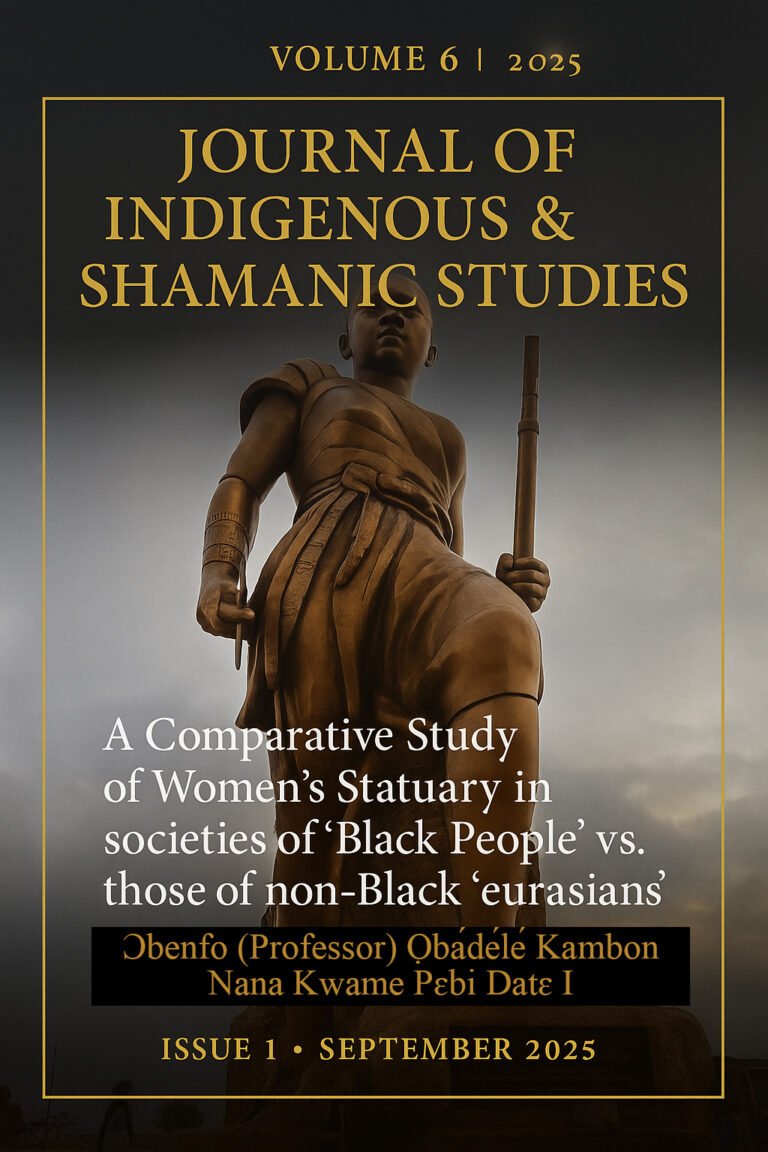
A Comparative Study of Women’s Statuary in societies of    Kmt(yw) ‘Black People’ vs. those of non-Black   ꜥꜣmw ‘eurasians’.

Ọbádélé Kambon

A Comparative Study of Women’s Statuary in societies of    Kmt(yw) ‘Black People’ vs. those of non-Black   ꜥꜣmw ‘eurasians’. Journal of Indigenous and Shamanic Studies, 6(1), 1-21.

Abstract, significance and citation data

Kambon, Ọ. (2025). A Comparative Study of Women’s Statuary in societies of    Kmt(yw) ‘Black People’ vs. those of non-Black   ꜥꜣmw ‘eurasians’. Journal of Indigenous and Shamanic Studies, 6(1), 1-21. This article refutes the  ꜥꜣmw ‘eurasians’-centric assertion of a universal scarcity of women’s statuary across time and geography (Baugher & Jameson, 2025). Anchored in the “Restoration of Maat” conceptual framework—rooted in the declaration from the Prophecy of  imAxw Nfrti ‘imAxw Neferti’ that  iw mAat r iit r st.s ‘Maat will come to her throne’, and    isft drti r rwti ‘isft expelled to the outside’—it challenges the premise that women have been historically underrepresented in visual culture. Instead, it demonstrates that such scarcity is a specific feature of ꜥꜣmw ‘eurasian’ societies…

An Analysis of the Connections Between Black Thought and the Culinary Ritual in the Context of Black Survival

Songsore, L., & Kambon, Ọ.

An Analysis of the Connections Between Black Thought and the Culinary Ritual in the Context of Black Survival. African Journal of Media & Society, 1(1).

Full record ↗ Download
Abstract, significance and citation data

In this article, we will draw an extended analogy between the centrality of Rꜥ ‘Ra, the Sun’ in the solar system and the centrality of food—literally and figuratively—in Black culinary traditions. We will do so by means of Extended Analogy Layering (Kambon 2017a) interpretive analysis, in which we will look at the literal centrality of collectively-eaten food in Malidoma Somé’s (1994) Of Water and the Spirit: Ritual, Magic, and Initiation in the Life of an African Shaman; Camara Laye’s (1954) The African Child; and Chinua Achebe’s (1958) Things Fall Apart as compared to the figurative centrality of Rꜥ ‘Ra, the Sun’ in life as attested in the Song to the itn ‘Aten’ (Obenga, 2004). We find that these contemporary and…

The Problematics of Intellectualising Indigenous Languages and People, a Cursory Look at the Science of Language in Literature and Formal Education.

Aketema, J., Kambon, Ọ., & Agyemang, B. K.

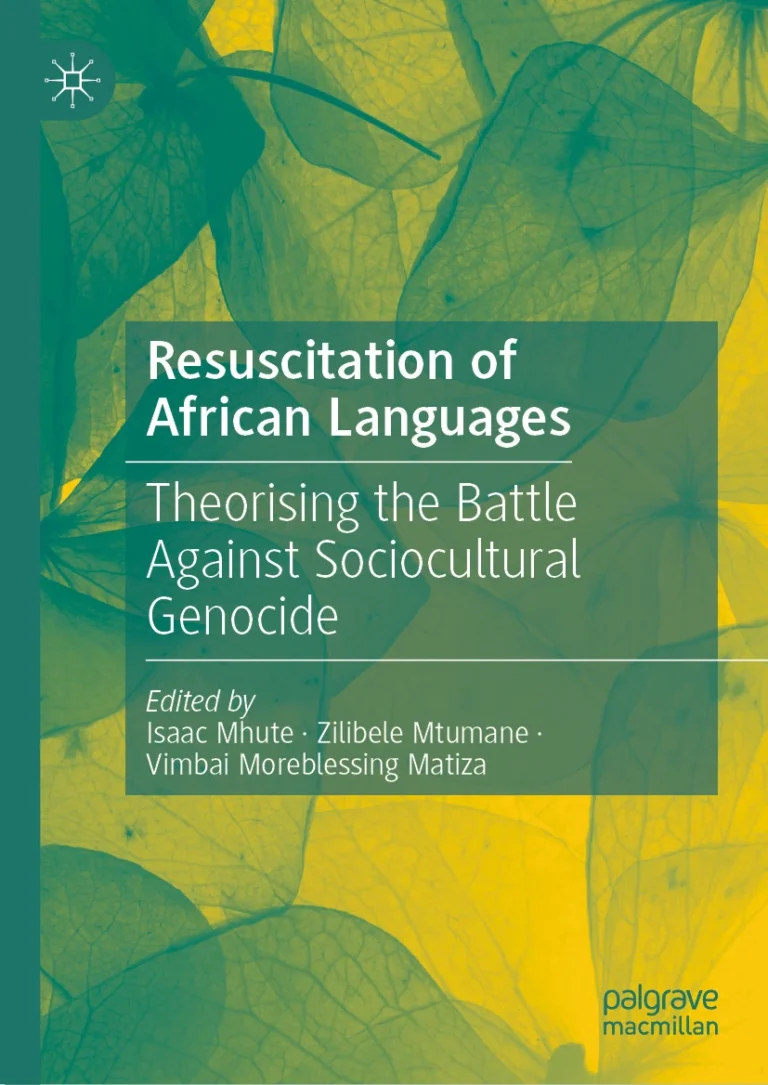
The Problematics of Intellectualising Indigenous Languages and People, a Cursory Look at the Science of Language in Literature and Formal Education. In I. Mhute, Z. Mtumane, & V. M. Matiza (Eds.), Resuscitation of African Languages: Theorising the Battle Against Sociocultural Genocide (pp. 17-43). Springer Nature Switzerland. https://doi.org/10.1007/978-3-031-81716-8_2

Abstract, significance and citation data

Since the 1960s, the debate about the discourse on indigenous languages and Black literature has engaged the attention of Black linguists and writers on the continent and beyond. Although research literature abounds with studies that illustrate the need and importance to intellectualise Black indigenous language in literature, it appears that there exist some entanglements. This chapter discusses the problematics of intellectualising indigenous language literature focusing on the question of indigenous Black literature and the problem of languages, the science and technology of indigenous language in the discourse of formal education, indigenous language as a carrier of culture and the plurality of Black literatures. The chapter concludes with some suggested antidotes to the problems.   Aketema, J., Kambon, Ọ., & Agyemang,…

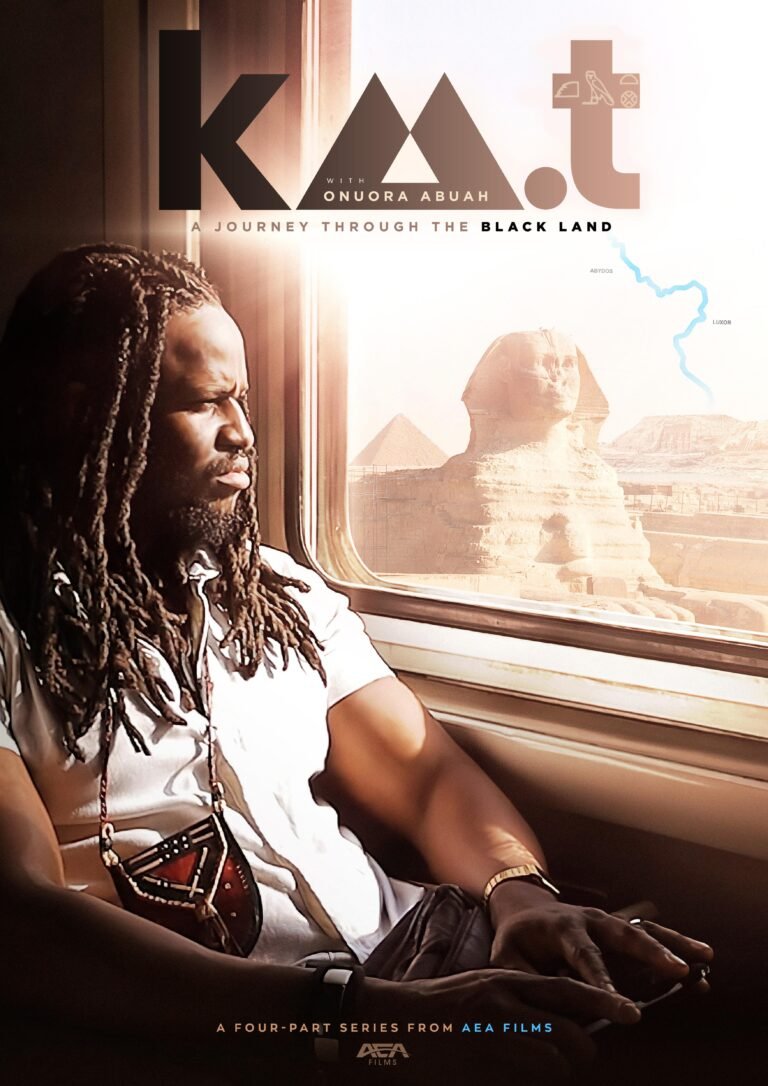
Km.T: A Journey Through the Black Land

Onuora Abuah, Uche Abuah, Kofi Asante-Wiredu, Ọbádélé Bakari Kambon

Abuah, Onuora, Uche Abuah, Kofi Asante-Wiredu, and Ọbádélé Bakari Kambon. 2024. Km.T: A Journey Through the Black Land. Documentary film.

Abstract, significance and citation data

Km.T: A Journey Through the Black Land is a powerful visual and intellectual journey into Kmt, the ancient Black civilization whose language, symbols, monuments, spiritual systems, and political imagination continue to speak across time. Moving beyond foreign names and inherited distortions, the film restores Kmt as Km.t, the Black Land, and centers the Kmt(yw) as Black people who named themselves, organized themselves, defended their land, honored their ancestors, and left behind a record of Abibitumi ‘Black Power’ that still has urgent meaning today. Through sacred landscapes, monumental architecture, primary texts, ancestral memory, and contemporary reflection, Km.T traces the continuity between the ancient Black Land and the ongoing struggle for Abibifahodie ‘Black Liberation.’ It invites viewers to see Kmt not as…

BibTeX

@misc{abuah2024kmt,
  author       = {Abuah, Onuora and Abuah, Uche and Asante-Wiredu, Kofi and Kambon, Ɔbenfo Ọbádélé Bakari},
  title        = {Km.T: A Journey Through the Black Land},
  year         = {2024},
  howpublished = {Documentary film},
  note         = {Journey through Kmt, the Black Land}
}

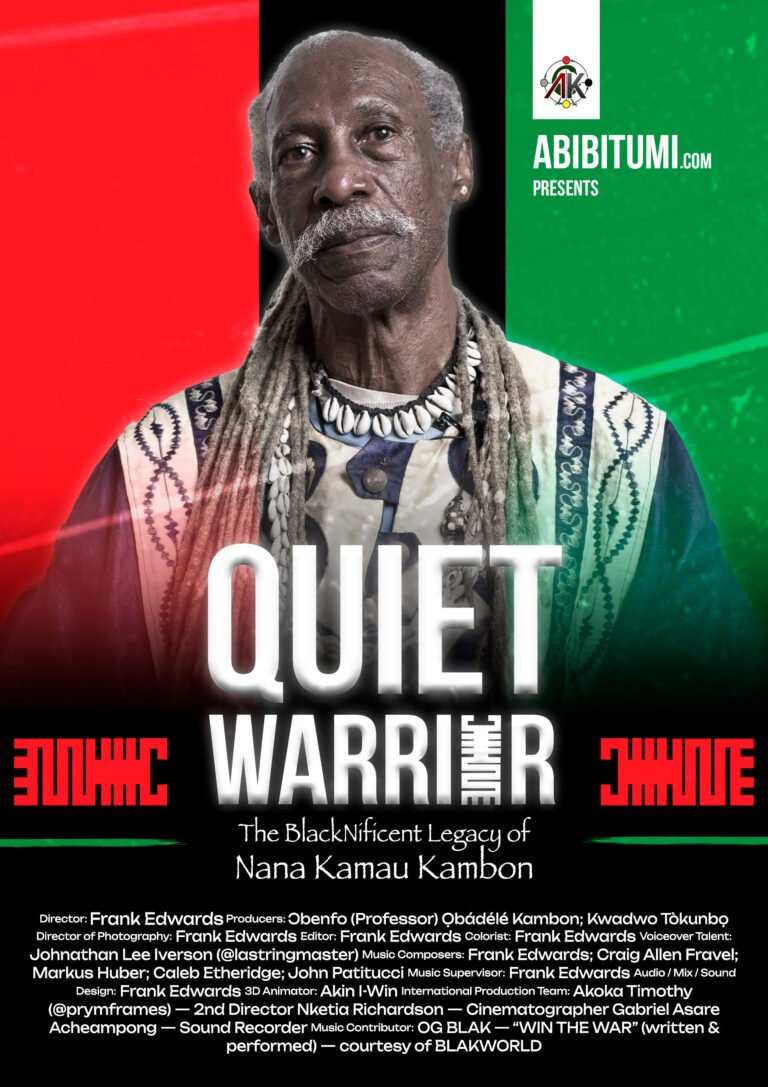
Quiet Warrior: The BlackNificent Legacy of Nana Kamau Kambon

Kambon, Ọ. (Producer), & Edwards, F. (Director).

Quiet Warrior: The BlackNificent Legacy of Nana Kamau Kambon [Documentary film]. Abibitumi.

Abstract, significance and citation data

Quiet Warrior: The BlackNificent Legacy of Nana Kamau Kambon is an intimate, voice-driven portrait of a thinker-organizer who led by disciplined example. Structured around Nana Kamau Kambon’s autobiographical narration, the film traces the formation of his worldview—how study, rigor, and principled struggle fused thought with action in service to Kmtyw ‘Black People’. Archival footage is deployed at key epiphanies—moments of rupture and clarity—that catalyzed shifts in how he thought, spoke, and lived his method. Rather than serving as background texture, the materials illuminate those turning points, revealing how insight became sharpened articulation and sustained practice. Testimonials from his family bring the interior life into focus: a loving husband and father whose unwavering courage walked hand-in-hand with tenderness; a teacher whose…

400 Years? Ancestors Disappear! Historical Misorientation and Disorientation in The Year of Return and the 400 Years Narrative.

Kambon, O., Songsore, L., & Aketema, J.

400 Years? Journal of African American Studies, Volume 27, Issue 3, Pages 1-25

Abstract, significance and citation data

Kambon, O., Songsore, L., & Aketema, J. (2023). 400 Years? Ancestors Disappear! Historical Misorientation and Disorientation in The Year of Return and the 400 Years Narrative. Journal of African American Studies, 27(3). 1619 ce was selected as the starting point in reference to enslaved Afrikans supposedly arriving at the British colony of Jamestown, Virginia as referenced on numerous Government of Ghana websites for 2019’s Year of Return. In this article, we will use various primary and scholarly sources to interrogate “white” epistemologies and anglocentric frames of reference of using 1619 ce as a starting point for anti-Black enslavement while challenging biblical parallels and references to 400 years (Brauchle 2015). Using an Afrikan-centered analysis, we argue that the arbitrary selection of…

Cardinal Numerals in Akan: A Construction Morphology Account

Clement Kwamina Insaidoo Appah, Reginald Akuoko Duah, Obadele Bakari Kambon

Ghana Journal of Linguistics, Volume 12, Issue 1, Pages 48-72

Abstract, significance and citation data

This paper presents a Construction Morphology account of complex cardinal numeral formation in Akan (Kwa, Niger-Congo). Through a detailed description of the Akan numeral system, which is decimal, we identify various ranges of cardinal numerals and show that they share structures with other constructions in the language because they are either compounds or coordinate constructions. We show that, consistent with crosslinguistic patterns, the two arithmetic operations that underpin the construction of cardinal numerals in Akan are addition and multiplication and they are formally realised differently. While multiplication is manifested mainly as compounding (and reduplication), addition is expressed mainly through compounding and coordination. The Construction Morphology framework allows us to account for the full range of Akan cardinal numerals in a…

Introduction to Aspects of Akan Verbal Semantics

E. Kweku Osam, Ọbádélé Bakari Kambon

Aspects of Akan Verbal Semantics, Pages 1-25

Abstract, significance and citation data

The paper by Duah examines various ways in which pain sensations are expressed in Akan. It argues that pain expressions in the language follow patterns known about the expressions of tastes, visions, and other instantiations of perception. He establishes that pain expressions behave structurally like causative constructions. Agyepong’s paper focuses on analysing Akan (Asante-Twi dialect) verbs that deal with the removal of the external coverings of various items. It examines the semantic characteristics and the argument alternation possibilities that such verbs participate in. She further explores the factors that determine the interpretation of such verbs in Akan. In Afreh’s paper, she explores the syntax and semantics of posture verbs in Akan in what has become known as the Basic Locative…

Mꜣꜥt ‘Maat’, Death and the Afterlife: Abstract Ideal and/or Lived Practice?

Joseph Aketema, Obadele Kambon

Journal of Religion in Africa, Volume 53, Issue 2, Pages 1-31

Abstract, significance and citation data

This study sets out to demonstrate how in classical and traditional Afrikan thought one’s afterlife on physical and spiritual planes is thought of as being commensurate with one’s adherence to Mꜣꜥt ‘Maat’ in terms of lived practice rather than simply as an abstract ideal. As such, we will interrogate textual examples from classical Kmt ‘The Black Nation/Land of the Blacks’ and attested lived examples from contemporary Afrika among the Kasena-Nankana with brief references to other cultural-linguistic groups. We demonstrate there is a shared understanding from the classical to the contemporary in terms of how one’s body is treated and how one’s experience in the afterlife is conceptualized. We find that conceptions of the afterlife have influenced how Afrikans engage Mꜣꜥt…

Semantic Integration as Emergence in Akan Serial Verb Constructions (SVCs) and Serial Verb Construction Nominalisation (SVCN)

Ọbádélé Bakari Kambon

Aspects of Akan Verbal Semantics

Abstract, significance and citation data

Kambon, Ọ. (2023). Semantic Integration as Emergence in Akan Serial Verb Constructions (SVCs) and Serial Verb Construction Nominalisation (SVCN). In E. K. Osam & Ọ. B. Kambon (Eds.), Aspects of Akan Verbal Semantics (pp. 152-202). Linguistics Association of Ghana. https://laghana.org/gjl/index.php/gjl/issue/view/24 Abstract This chapter aims to draw a conceptual and theoretical link between semantic integration in Akan Serial Verb Construction Nominalization and the concept of emergence as articulated in chemistry, physics, biology, neuroscience, philosophy, art and systems theory among others. I argue that the degree to which semantic integration/emergence pertains at the (serial) verb construction level may correlate to nominalisation for that class of serial verb construction or lack thereof.  Therefore, in the case of Akan SVCNs, three categories of SVCs are analysed on…

Combating cultural imperialism & cultural misorientation to preserve Afrikan intangible cultural heritage

Ọbádélé Kambon, Lwanga Songsore

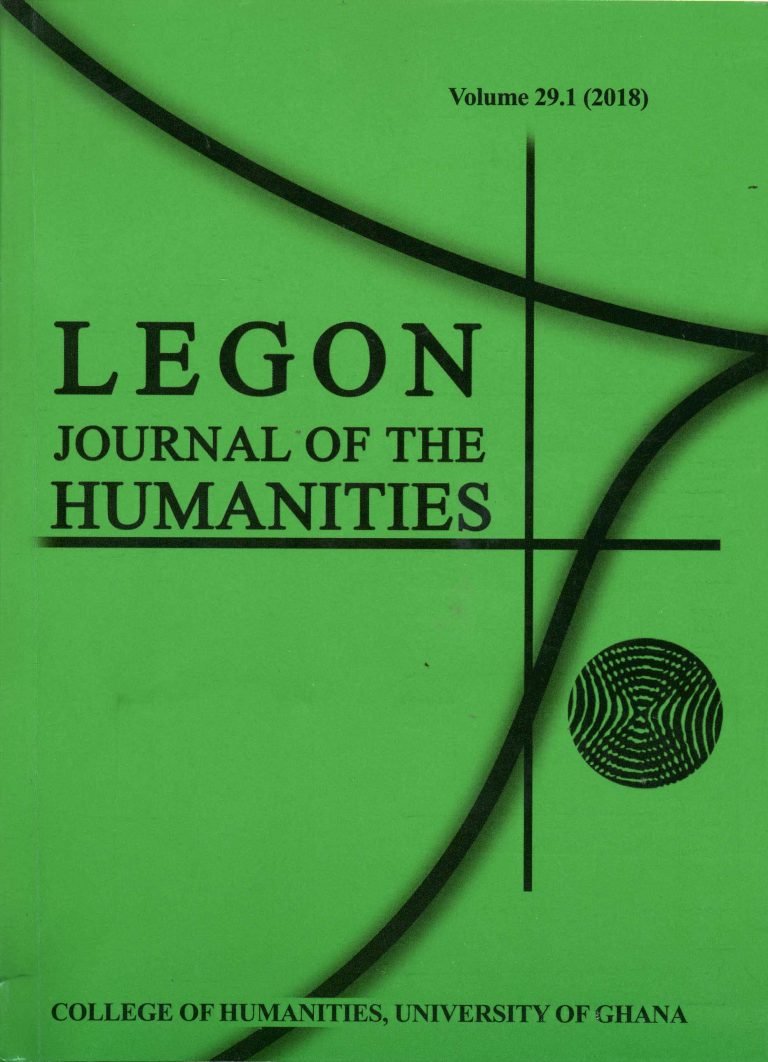
Legon Journal of the Humanities, Volume 33, Issue 1

Abstract, significance and citation data

Kambon, Ọ., & Songsore, L. (2022). Combating cultural imperialism & cultural misorientation to preserve Afrikan intangible cultural heritage. Legon Journal of the Humanities, 33(1), 114-137. https://dx.doi.org/10.4314/ljh.v33i1.5   Abstract: This study aims to address combating cultural imperialism and cultural misorientation to preserve Afrikan=Black intangible cultural heritage noting that the priority must be on indigenous Afrikan=Black people to push our own agenda. The study takes the 2019 UNESCO-ICM Open School as a case study in terms of substantive efforts (or lack thereof) to combat cultural imperialism and cultural misorientation. The study addresses matters of terminology, the implications of using the equal sign between Afrikan and non-Afrikan concepts, cultural misorientation and disorientation, false narratives and alien-self/anti-self-disorders, soft power, what must be done in…

A Crosslinguistic Study of Body Part Expressions in Classical and Contemporary Afrikan Languages: Akan, Yorùbá, Kiswahili and mdw nTr

Ọbádélé Bakari Kambon & Lwanga Songsore

Ghana Journal of Linguistics, Volume 10, Issue 1, Pages 150–176

Abstract, significance and citation data

This study aims to discuss body part expressions in Akan (a Ghanaian language), Yorùbá (a Nigerian language), Kiswahili (a Tanzanian language) and r n Kmt ‘lit. the language of the Black Nation’. The paper addresses the common worldview whereby the concept and its articulation maintain a close connection to the literal real-world referent (the body part in question). The data is taken from collections of previously attested oral and written texts. The study demonstrates that there is a shared worldview continuum from ancient to contemporary Afrikan languages as manifested in body part expressions and that degree of proximity and similarity can be charted along a fundamental interrelation/fundamental alienation continuum.

Fiction vs. Evidence: A Critical Review of Ataa Ayi Kwei Armah’s Wat Nt Shemsw and the Eurasian Rhetorical Ethic

Ọbádélé Bakari Kambon & Lwanga Songsore

African and Asian Studies, Volume 20, Issues 1-2, Pages 124-153.

Abstract, significance and citation data

Fiction vs. Evidence: A Critical Review of Ataa Ayi Kwei Armah’s Wat Nt Shemsw and the eurasian Rhetorical Ethic Ọbádélé Bakari Kambon Senior Research Fellow, Institute of African Studies, University of Ghana, Legon, P.O. Box LG 1149, obkambon@staff.ug.edu.gh Lwanga Songsore PhD Student, Institute of African Studies, University of Ghana, Legon, P.O. Box LG 25, Legon, Accra, Ghana, sungsongsore@gmail.com m Dd grg iw.k wrt NEG.IMPER speak falsehood STAT.2M.SG great (one) ‘Tell no falsehood, you are a great one.’ (Bak 2016: 227) Abstract At the 2018 Great African Thinkers Conference on Nna Chinweizu, attendees—the first author included—took a pledge that “In all branches of our lives, we must be capable of criticizing and of accepting criticism. But criticism, proof of the willingness…

Maat and the Rebirth of Kmt ‘Land of Black People’: An Examination of Beatty’s Djehuty Project

Joseph Aketema, Ọbádélé Bakari Kambon

Filosofia Theoretica: Journal of African Philosophy, Culture and Religions, Volume 10, Issue 2, Pages 47-76

Full record ↗ Download
Abstract, significance and citation data

In this paper we examine Ɔbenfo Mario H. Beatty’s chapter, ‘Maat the Cultural and Intellectual Allegiance of a Concept’ in terms of its articulation of MꜢꜤt ‘Maat’. This examination sets out to delineate how a return to the principles inherent in MꜢꜤt ‘Maat’ can serve to bring about the Wḥm Mswt ‘Rebirth/Renaissance’ of Kmt ‘Land of Black People’ and Kmt(yw) ‘Black People’ economically and politically. This research is significant in that it points us away from the semantically vacuous and etymologically opaque terms “Africa” and “Africans” to terminology, principles and practices that restore our original identity as Kmt(yw) ‘Black People’.

A Smart Ghana Repatriation Guide

Of Repatriation, Rivers and Rivulets

Kambon, Ọ.

A Smart Ghana Repatriation Guide. Washington, DC: Adinkra Group.

Abstract, significance and citation data

Kambon, O. (2021). Of Repatriation, Rivers and Rivulets. In A Smart Ghana Repatriation Guide. Adinkra Group. https://books.google.com.gh/books?id=laXbzQEACAAJ This chapter addresses the need for those who intend to repatriate to focus on what we have in common as Kmtyw 'Black people' rather than that which separates us. This point is forcefully driven home using the river/rivulet analogy. Further, using primary texts from classical Kmt, the author demonstrates the classical tradition of referring to ourselves as Black people on a collective and individual level, culminating in a discussion on how this practice is relevant for modern-day Kmtyw 'Black people.'

Politicians, Prostiticians, and The Ghana-United States Military Base Agreement: What happens when you let the united snakkkes into your home?

Kambon, O., & Yɛboah, R. M.

Turning the Tide: Journal of Inter-communal Solidarity, Volume 33, Issue 1

Abstract, significance and citation data

Abstract: In this paper, we reject the argument put forward by some stakeholders that the United States is not actually establishing a military base by utilizing the U.S. Department of Defense's own definition of "base". Then, we demonstrate point for point how the agreement fits every aspect of the definition of a base via textual analysis. We then present research on how the US routinely violates treaties, pacts and agreements focusing on two case studies: the 1993 Chemical Weapons Convention and the 1963 Vienna Convention on Consular Relations (Koplow, 2013). We demonstrate that the u.s. does not keep its word and that this tradition continues with Donald Trump, though it certainly did not start with him. We conclude with the significance…

T.R.H. Nana Marcus Mosiah Garvey’s “Universal Negro”, Nana Kwame Nkrumah’s “All-African,” and the Theory of Intraspecific Aggressive Ideological Mimicry (AIM)

Ọbádélé Bakari Kambon & Lwanga Songsore

Eastern Africa Social Science Research Review, Volume 38, Issue 1.

Abstract, significance and citation data

This paper explores ethological and sociological parallels drawing upon research on interspecific and intraspecific aggressive mimicry. In aggressive mimicry, the mimic imitates the model, oftentimes to achieve predatory or parasitic ends. By looking at articulated thoughts, words, and actions as covered in this study, we advance the idea that “All-Africanism” is an ideological mimic with respect to authentic Pan-Afrikanism[1] centered on Black Power and the Black Survival Thrust. In fine, in their role as predators/parasites, All-Africanists lure in unsuspecting prey/hosts via a simple bait-and-switch strategy commonly seen in ethological contexts. In such contexts, mimicry can be visual, acoustic, chemical, tactile, electric, or any combination of these sensory modalities (Dalziell & Welbergen, 2016). We find that, similar to observations made in…

Capoeira, Its Value as ICH and the Open School Project: Experiences and Reflections

Ọbádélé Bakari Kambon

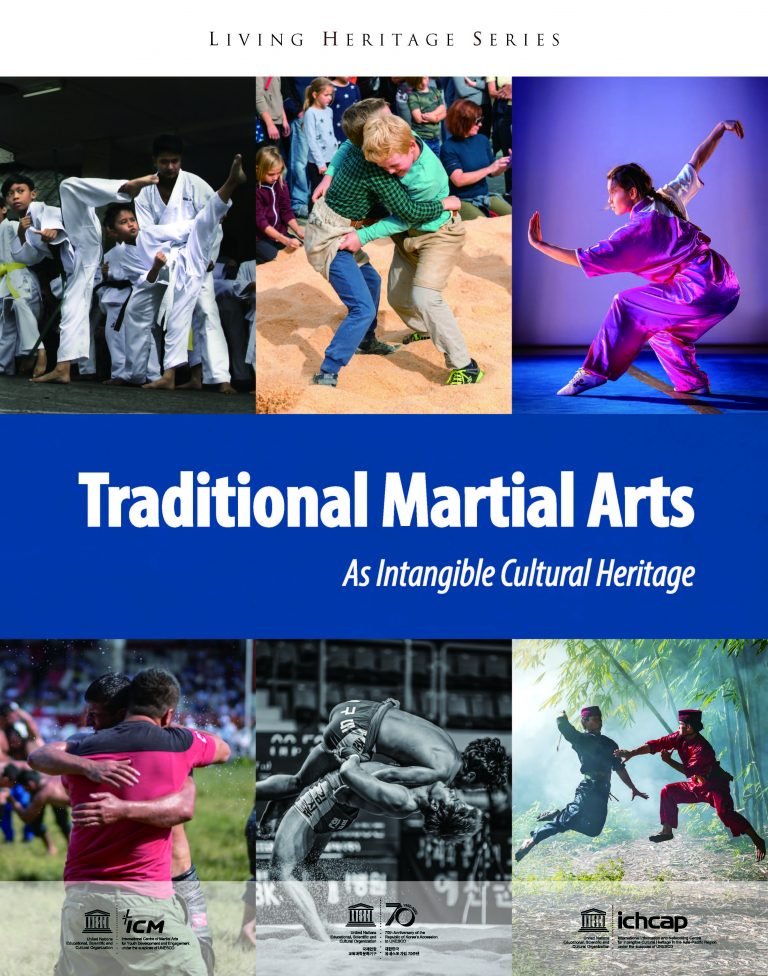
Traditional Martial Arts As Intangible Cultural Heritage (pp. 17-28). Chungju-si: UNESCO-ICM.

Abstract, significance and citation data

Kambon, O. (2020). Capoeira, Its Value as ICH and the Open School Project: Experiences and Reflections. In P. Seong-yong & R. Seok-yeol (Eds.), Traditional Martial Arts As Intangible Cultural Heritage (pp. 17-28). Chungju-si: UNESCO-ICM.

Editorial Book Critique: The Origin of the Word Amen: Ancient Knowledge the Bible has Never Told

Ọbádélé Bakari Kambon

Ghana Journal of Linguistics, 9(1), 72-96.

Abstract, significance and citation data

The Origin of the Word Amen: Ancient Knowledge the Bible has Never Told is a book that promises to pique the interest of any reader interested in classical  Kmt ‘Black Nation/Land of the Blacks’,  mdw nTr ‘Hieroglyphs,’ the Akan language, and historical-linguistic connections between the three. Specifically, the book promises to deliver information about how the word  imn ‘Amen,’ as attested in classical  Kmt ‘Black Nation/Land of the Blacks,’ persists in the contemporary Akan language. While under a steady hand this should be a simple enough thesis to substantiate, unfortunately, the authors’ obvious lack of grounding in historical linguistics, their lack of knowledge of  mdw nTr ‘Hieroglyphs’ as well as their lack of understanding the morphology (word structure) of the…

Maat vs. the Statue of Égalité: A Critical Analysis of Ataa Ayi Kwei Armah’s Wat Nt Shemsw: The Way of Companions.

Ọbádélé Bakari Kambon, Lwanga Songsore, Yaw Mankatah Asare

Legon Journal of the Humanities, Volume 30, Issue 2, Pages 33-65

Abstract, significance and citation data

In this paper, we endeavor to restore Mꜣꜥt ‘Maat’ as truth to her rightful place by challenging erroneous and demonstrably incorrect notions as they appear in Ataa Ayi Kwei Armah’s Wat Nt Shemsw: The Way of Companions. By cross-referencing Ataa Armah’s vague allusions to “ancient Egyptian” mythology with actual textual documentation from Kmt ‘Black Nation/Land of Blacks’ (so-called “ancient Egypt”), we will interrogate the assertions made about the myths of the kmt(yw) ‘Black people’. We fi nd that where Ataa Armah’s statements are at odds with the texts of Kmt ‘Black Nation/Land of Blacks,’ it is necessary to bring this information to light so that the reader can learn the actual content of these myths for themselves. In conclusion, we…

On the Structure of Causatives in Akan

Duah, R. Akuɔko & Ọbádélé Kambon

Journal of West African Languages, 47(2), 1-22.

Abstract, significance and citation data

In this article, we discuss the syntactic properties and structure of two analytic causative constructions, which we have referred to as the ‘no’ causative and ‘ɔ’ causative, in Akan (Kwa, Niger-Congo). We show that although the two analytic causative constructions have often received a unitary analysis as a serial verb construction (e.g. Osam 1994, 2004; Agyeman 2002; Morrison 2007) they, in fact, exhibit different syntactic behavior and structure in the language. In this vein, we apply Haspelmath’s (2016) definitional criteria for serial verb constructions as a diagnostic for the two causatives and show that while one of the causatives behaves similar to a serial verb construction the other does not but displays clausal embedding. We argue that the ‘no’ causative…

Humanities and Sciences as Complementary Aspects of an Afrikan=Black Whole: Evidence from Archeoastronomy

Ọbádélé Bakari Kambon, Yaw Mankatah Asare

Legon Journal of the Humanities, Volume 30, Issue 2, Pages 215-242

Abstract, significance and citation data

Kambon, Ọ., & Asare, Y. M. (2019). Humanities and Sciences as Complementary Aspects of an Afrikan=Black Whole: Evidence from Archeoastronomy. Legon Journal of the Humanities, 30(2), pp. 215-242.

Ku Nseke and Ku Mpèmba: The Dikènga Theory as Evinced Through Content and Function of Akan Ananse Stories and Yorùbá Ìjàpá Tales

Ọbádélé Kambon

Contemporary Journal of African Studies, Volume 6, Issue 2, Pages 1-22

Abstract, significance and citation data

Kambon, Ọ. (2019). Ku Nseke and Ku Mpèmba: The Dikènga Theory as Evinced Through Content and Function of Akan Ananse Stories and Yorùbá Ìjàpá Tales. Contemporary Journal of African Studies, 6(2). The aim of this paper is to highlight parallels between Akan Ananse Stories and Yorùbá Ìjàpá tales. In this article, connections are made with regard to function and content of Akan and Yorùbá stories using Dikenga, the cosmogram of the Bakôngo, as a tool for oral literary analysis revealing intertextual parallels (Ọ Kambon, 2017). We highlight six (6) sets of stories common to both Akan and Yorùbá people differentiated primarily by the main character being the spider or the tortoise. Further, we show how the stages of transformation of…

What Afrikan Names May (or May Not) Tell Us About the State of Pan-Afrikanism

Obadele Kambon, Roland Mireku Yeboah

(2019). What Afrikan Names may (or may not) Tell Us about the State of Pan-Afrikanism. Journal of Black Studies, 50(6), pp. 569–601.

Abstract, significance and citation data

Names are important to Afrikan=Black people of the continent and diaspora as, traditionally, one’s name is seen as playing a crucial role in the fulfilment (or lack thereof) of one’s life purpose (Obeng, 2001). However, due to enslavement and neo-enslavement in the diaspora as well as colonialism and neo-colonialism on the continent, many Afrikan=Black people now give their children the names of their enslavers or colonial enemies. In this paper, we utilize a comparative anthroponymy analysis making use of case studies from two institutions; namely the Institute of African Studies (IAS)-University of Ghana at Legon and Abibitumi Kasa, with locations in Raleigh, North Carolina and Accra, Ghana, in order to observe how some Afrikan=Black people adopt Eurasian names and/or reclaim…

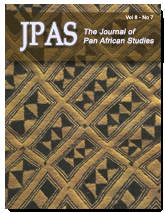
Obadele Kambon Journal of Pan-African Studies

Afrikan=Black Combat Forms Hidden in Plain Sight: Engolo/Capoeira, Knocking-and-Kicking and Asafo Flag Dancing

Ọbádélé Bakari Kambon

Africology: Journal of Pan-African Studies, Volume 12, Number 4, October 2018

Abstract, significance and citation data

ABSTRACT: This paper presents a Pan-Afrikan tri-continental analysis of Afrikan/Black combat sciences, and in this, it challenges the erroneous notion that the dance-like movements of Afrikan combat sciences originated in attempts to trick enslavers. Therefore, this work demonstrates that Afrikan combat sciences, regardless of location, grow out of a shared worldview informed by practical considerations that are effective and time-tested. Further, the contemporary expressions of Engolo/Capoeira, Knocking-and-Kicking, and Asafo Flag Dancing are examined by means of a comparison between natural vs. unnatural responses to oppression.

Haiti, Morocco and the AU: A Case Study on Black Pan-Africanism vs. anti-Black continentalism

Ọbádélé Bakari Kambon & Roland Mireku Yeboah

CODESRIA: Identity, Culture, And Politics, Volume 19, Issues 1-2, Pages 41-64

Abstract, significance and citation data

Abstract: In 2016 Haiti, which was mentioned by name at the 1900 Pan-African Conference (at which the term pan-Africanism was coined), applied to join the African Union but was denied. In that same year, Morocco, in which an estimated 219,700 people are currently held as عبد‎ ‘Abeed’ (a word meaning both slave and Black person interchangeably), applied to join the African Union and was accepted as a full member (El Hamel, 2013). Using news articles and contemporary data procured from a variety of sources, in this paper, we will examine the Haiti vs. Morocco treatment at the hands of the AU as a manifestation of the ongoing struggle between the original Black Pan-Afrikanism and the modern-day counterfeit version also known…

Theory and description in African Linguistics

Serial Verb Nominalization in Akan: The Question of Intervening Elements

Kambon, Ọ., Duah, R., & Appah, C.

(2018). Serial verb nominalization in Akan: The question of intervening elements. In E. Clem, P. Jenks & H. Sande (eds.), Theory and description in African Linguistics: Selected papers from ACAL 47 (361–386). Berlin: Language Science Press.

Abstract, significance and citation data

Kambon, Ọ., Duah, R., & Appah, C. (In press, 2018). Serial verb nominalization in Akan: The question of intervening elements. In E. Clem, P. Jenks & H. Sande (eds.), Theory and description in African Linguistics: Selected papers from ACAL 47 (361–386). Berlin: Language Science Press. ABSTRACT: In this paper, we hope to disambiguate the nature of look-alike intervening elements that appear between verbs in Serial Verb Constructions (SVCs) and Serial Verb Construction Nominalizations (SVCNs). To do so, we will first show that these intervening elements share the same phonological form. We will then show that although the intervening elements look the same on the surface, they can be differentiated by appealing to semantics and the construction from which the SVCN is derived. In…

skhmkht_ea_on_love_sublime__15006.1526234886.1280.1280
2018 Book

Skhmkht Ea

Shemsw Bak

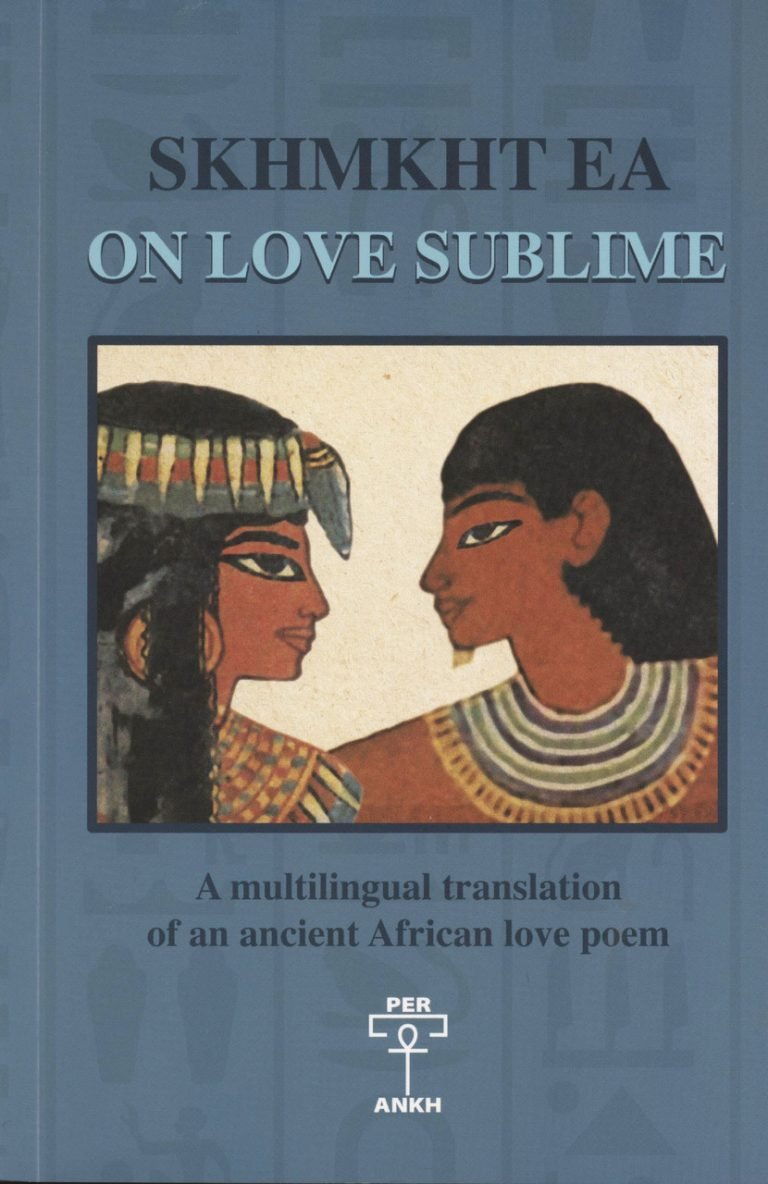
Skhmkht Ea: On Love Sublime: A multilingual translation of an ancient African love poem. Popenguine, Senegal: Per Ankh. (Yorùbá Translation)

Full record ↗
Abstract, significance and citation data

Bak, Shmsw. (2018). Skhmkht Ea: On Love Sublime: A multilingual translation of an ancient African love poem. Popenguine, Senegal: Per Ankh. (I contributed the Yorùbá translation to this project)

The Pro-Indo-Aryan Anti-Black M.K. Gandhi and Ghana’s #GandhiMustFall Movement

Kambon, Ọ., & Appiagyei-Atua, K.

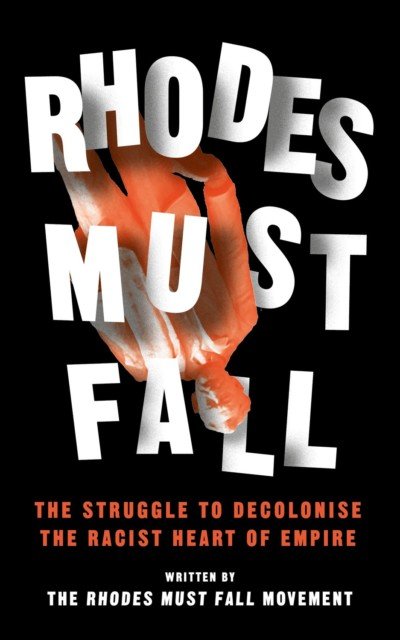
(2018). The Pro-Indo-Aryan Anti-Black M.K. Gandhi and Ghana’s #GandhiMustFall Movement. In Oxford Rhodes Must Fall Movement (Ed.), Rhodes Must Fall: The Struggle to Decolonise the Racist Heart of Empire. London: Zed Books.

Abstract, significance and citation data

Kambon, Ọ., & Appiagyei-Atua, K. (2018). The Pro-Indo-Aryan Anti-Black M.K. Gandhi and Ghana’s #GandhiMustFall Movement. In Oxford Rhodes Must Fall Movement (Ed.), Rhodes Must Fall: The Struggle to Decolonise the Racist Heart of Empire. London: Zed Books. ABSTRACT: “I venture to point out that both the English and the Indians spring from a common stock, called the Indo-Aryan […] A general belief seems to prevail in the Colony that the Indians are little better, if at all, than savages or the Natives of Africa. Even the children are taught to believe in that manner, with the result that the Indian is being dragged down to the position of a raw Kaffir” (Mohandas Karamchand Gandhi, 1999, Vol. I, p. 193). In…

2018 Book

Therapeutic Communication Competencies for Nurses and Midwives

Amfo, Nana Aba Appiah, Tọ́pẹ́ Ọmọniyì, Nii Teiko Teigo, Ọbádélé Kambon, and Kofi Korankye Saah

Therapeutic Communication Competencies for Nurses and Midwives. Tema: Digibooks.

Full record ↗ Download
Abstract, significance and citation data

Abstract Development in nursing and midwifery practice around the world shows rather clearly that healthcare is a collaborative phenomenon between the carers and those to whom they have a duty of care. Previously, it was perceived as a one-directional operation in which the sick sought solutions to health problems from professionals who purportedly have all the answers. But a new holistic approach to the practice of nursing and midwifery reveals that patients and healthcare professionals are in fact engaged in a very significant social relationship. One that has a positive bearing on the outcome of any interventions that may be undertaken in addressing the health issues of patients. If the relationship works, there is the likelihood that the quality of…

CJAS 4(2) Cover

Akan Ananse Stories, Yorùbá Ìjàpá Tales, and the Dikenga Theory: Worldview and Structure

Kambon, Ọ

Contemporary Journal of African Studies, 4(2), 1-36.

Abstract, significance and citation data

Abstract In this paper, we aim to use Dikenga, the cosmogram of the Bakôngo, as an Afrikan cosmological, philosophical, conceptual, and theoretical framework to analyze the structure of Akan Ananse and Yorùbá Ìjàpá stories. According to Fu-Kiau, “nothing exists that does not follow the steps of the cyclical Kongo cosmogram” (Fu-Kiau 1994: 26). This bold hypothesis is tested in this study by applying what we term the “Dikènga theory of literary analysis” to the aforementioned stories. We find that this theoretical framework can help us shift away from concepts of “storylines” and “timelines” to reveal the patterned and cyclical nature of material, spatial and temporal phenomena. Further, we find such an approach may deepen our understanding of these stories as…

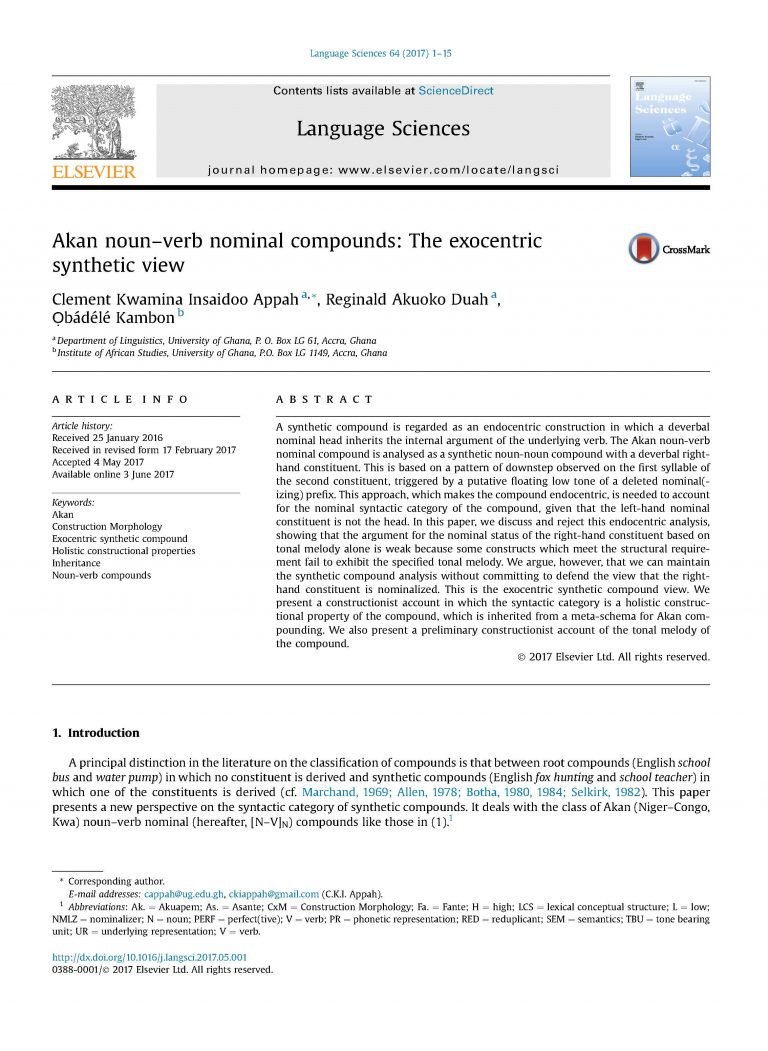
Akan noun–verb nominal compounds: The exocentric synthetic view

Appah, C. K. I., Duah, R. A., & Kambon, Ọ

Language Sciences, 1-15. https://doi.org/10.1016/j.langsci.2017.05.001

Abstract, significance and citation data

Abstract A synthetic compound is regarded as an endocentric construction in which a deverbal nominal head inherits the internal argument of the underlying verb. The Akan noun-verb nominal compound is analysed as a synthetic noun-noun compound with a deverbal righthand constituent. This is based on a pattern of downstep observed on the first syllable of the second constituent, triggered by a putative floating low tone of a deleted nominal(-izing) prefix. This approach, which makes the compound endocentric, is needed to account for the nominal syntactic category of the compound, given that the left-hand nominal constituent is not the head. In this paper, we discuss and reject this endocentric analysis, showing that the argument for the nominal status of the right-hand…

An Intertextual Analysis of Jími Ṣólańkẹ́'s Ọ̀nà Là in 'The Path' and the Multiple Star System Theory of Mutual Illumination and Interaction

Kambon, Ọ

Legon Journal of the Humanities, 28(1), 62-78.

Abstract, significance and citation data

Abstract The concept of mutual illumination between texts, genres, arts, and disciplines has been used in scholarly work for decades (Weisstein, 1973, 1993). Nevertheless, much of this literature lacks a firm anchor with regard to a literal source of the analogy “mutual illumination.” We argue that by observing natural phenomena that actually mutually illuminate, influence and otherwise affect each other, greater insight into how texts interact in similar ways can be achieved. Thus, drawing concepts from astrophysics, with specific reference to multiple star systems, a conceptual framework is derived in which analogous relations are proposed and interrogated. This framework couches the discussion in a stylistic analysis of our primary text, Jími Ṣólańkẹ́'s Ọ̀nạ̀ Lạ̀, which is analyzed both on its own…

Intellectual Warfare, Theory and Practice: Gates, Thornton, White World Terror Domination and the War on Afrocentricity

Kambon, Ọ.

Africology: The Journal of Pan African Studies, 10(3), 75-99.

Abstract, significance and citation data

Abstract This article provides an analysis of attempts to conceal white culpability in the enslavement of Afrikan people, in service of white world terror domination as perpetrated by Henry Louis “Skip” Gates, Jr. and John Thornton. Thus, the white terrorist/anti-Afrikan/anti-Black integrationist imperative is examined in Gates’ “Wonders of the African World” (1999) and Thornton’s Africa and Africans in the Making of the Atlantic World, 1400-1800 (1998), and in earlier historical appropriations and subversions implemented by white terrorists of various types, with or without the assistance of their anti-Afrikan/anti-Black collaborators. Keywords: Afrocentricity, intellectual warfare, white supremacy, war, hotep.

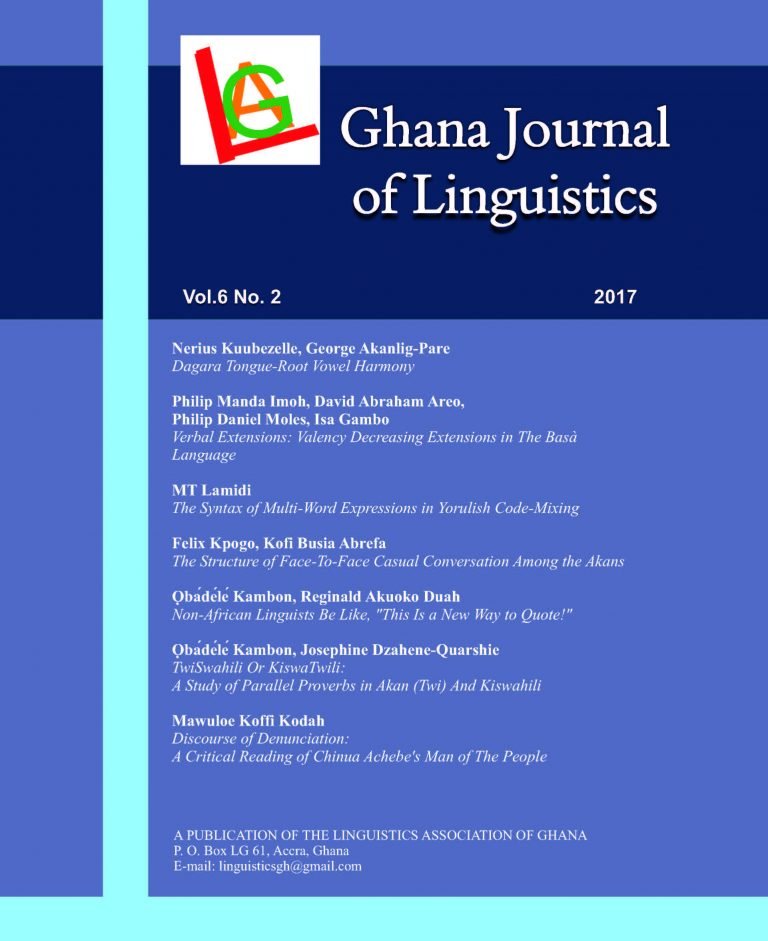
Non-African Linguists Be Like, “This Is a New Way to Quote!”

Ọbádélé Kambon, Reginald Akuoko Duah

Ghana Journal of Linguistics - Special Issue 6 (2):85-115. doi: http://dx.doi.org/10.4314/gjl.v6i2.5.

Abstract, significance and citation data

Abstract The objectives of this paper are to show that quotative like, while relatively new to colloquial varieties of (white) English, is attested in varieties of African speech of the continent (represented by Akan (Asante Twi)) and the diaspora (represented by Anti-American African (AAA))[1] decades, if not over a century prior. Secondly, we show that there are similar bases for grammaticalization for Akan (Asante Twi) sɛ and AAA like whereby they have gone from showing resemblance/approximation to serving as quotatives. Thus, we provide examples from AAA and Akan (Asante Twi) to demonstrate correlations between the two quotatives using primary text research and analyses based on a variety of sources placing the putative origin of quotative like into the collective African…

Recalling a Common Struggle for Pan-Africanism: Nkrumah’s and Nasser’s Policies on the Congo Crisis (1960-1966)

Abdellatif, M., & Kambon, Ọ.

Revisiting African Studies in a Globalized World (pp. 63-76). Tema, Ghana: Smartline.

Abstract, significance and citation data

Abstract While the historiography of Africa’s decolonization has had several versions, only a few versions show commitment to the methodological imperatives demanded by the study of history in general (Philips, 2005, p. 496). During the decolonization, all historians, Africanists or not, have taken to this field of study with different view of points. While some historians followed the concept of “Colonisabilité” as Malek Bennabi indicated, others proposed new methods in the writing of African history such as Molefi Kete Asante who rejected the theory of “Eurocentricity” and introduced the theory of “Afrocentricity” (Asante, 2012, p. 55; Bennabi & Benamara, 2003, p. 177). In the early years of the 1960s, African history witnessed one of the strongest crises which broke out…

political communication in africa

Singing Truth to Power and the Disempowered: The Case of Lucky Mensah and his Song, “Nkratoɔ”

Kambon, Ọ., & Adjei, G. K.

Political Communication in Africa (pp. 133-158). Berlin: Springer

Abstract, significance and citation data

Abstract Political communication in Africa increasingly manifests characteristics of a dialogue or conversation rather than the monologue it may be perceived to be, especially in light of the proliferation of new media and innovative means of dissemination (including the internet and concomitant mobile apps). This work focuses on Nkratoɔ 'Message' by Alex Lucky Mensah, which is sung in the Akan language of Ghana.

TwiSwahili Or KiswaTwili: A Study of Parallel Proverbs in Akan (Twi) And Kiswahili

Ọbádélé Bakari Kambon, Josephine Dzahene-Quarshie

Twiswahili or Kiswatwili: A Study of Parallel Proverbs in Akan (Twi) and Kiswahili. Ghana Journal of Linguistics - Special Issue, 6(2), 116-153.

Abstract, significance and citation data

Abstract In Akan and Kiswahili, there are several proverbs that express the same underlying idea, oftentimes in the exact same or similar ways. There are several possible reasons why these parallel proverbs exist. In one line of thinking, the similarities may be due to contact phenomena facilitating shared cultural and/or historical experiences. Another perspective is that the similarities may be due to the demonstrably genetic relationship between Akan and Kiswahili as languages of the Niger-Congo phylum. In this study, however, we will examine these proverbs in parallel or near-parallel and demonstrate that regardless of the facts of the two aforementioned lines of inquiry, they attest to a shared African worldview and can be analyzed in terms of measured proximity and…

Kambon, Ọ., Osam, E. K., & Amfo, N. A. (2015). A Case for Revisiting Definitions of Serial Verb Constructions – Evidence from Akan Serial Verb Nominalization. Studies in African Linguistics, 44(2), 75-99. http://sal.research.pdx.edu/PDF/442Kambon.pdf

A Case for Revisiting Definitions of Serial Verb Constructions – Evidence from Akan Serial Verb Nominalization

Kambon, Ọ., Osam, E. K., & Amfo, N. A.

Studies in African Linguistics, 44(2)

Abstract, significance and citation data

Abstract In this study, we undertook an experiment in which native speakers of Akan were given serial verbs both with and without oblique non-verbal elements (such as relator nouns, direct objects, postpositions, etc.) and asked them to construct Serial Verb Construction Nominals (SVCNs) from them. We found that, by and large, when not given said nonverbal elements, speakers were not able to construct nominal forms. In another task, we gave speakers nominal forms and asked them to deconstruct them to the constituent serial verbs from which they were derived. Time and again, speakers gave, not only the serial verbs, but also the non-verbal elements even though they were not asked to do so. Gestalt meanings were also given by speakers…

Kambon, Ọ. (2015). Acquisition of African Languages. In M. J. Shujaa & K. J. Shujaa (Eds.), Encyclopedia of African Cultural Heritage in North America (pp. 105-109). Thousand Oaks, CA: Sage Publications, Inc. http://knowledge.sagepub.com/view/the-sage-encyclopedia-of-african-cultural-heritage-in-north-america/i1533.xml

Acquisition of African Languages

Kambon, Ọ

Encyclopedia of African Cultural Heritage in North America (pp. 105-109). Thousand Oaks, CA: Sage Publications, Inc.

Abstract, significance and citation data

Abstract The acquisition of African languages may refer to past or contemporary learning of African languages either unconsciously through native speaker acquisition (L1) or with conscious intentionality as a second language (L2). The acquisition of African languages is relevant to African cultural heritage in North America by virtue of the fact that language is the primary vehicle by which culture is transmitted intergenerationally. Therefore, the acquisition of African languages serves as a powerful exemplar of African cultural continuity in the North American context. This entry discusses the acquisition of African languages from the past to more recent times to gain a broader understanding of the interrelated processes and manifestations of African cultural retention and continuity.

Kambon, Ọ. (2015). Acquisition of African Languages. In M. J. Shujaa & K. J. Shujaa (Eds.), Encyclopedia of African Cultural Heritage in North America (pp. 105-109). Thousand Oaks, CA: Sage Publications, Inc. http://knowledge.sagepub.com/view/the-sage-encyclopedia-of-african-cultural-heritage-in-north-america/i1533.xml

Africanisms in Contemporary English

Kambon, Ọ

The SAGE Encyclopedia of African Cultural Heritage in North America (Vol. 1, pp. 192-198). Thousand Oaks, CA: SAGE Publications, Inc.

Abstract, significance and citation data

Abstract Africanisms in contemporary English (CE) may refer to direct modern borrowings or loans from African languages or intergenerational inheritances from past borrowings. Culturo-linguistic contact is at the root of Africanisms in contemporary English and may occur in areas including, but not limited to, syntax, morphology, phonology, phonetics, and pragmatics. This entry will focus on Africanisms in contemporary English, with particular focus on Ebonics, both as inheritances from the past as well as more recent imports, to gain a broader understanding of the interrelated processes and manifestations of African cultural retention and continuity within the North American context. In what follows, examples from African languages and CE are provided to show parallels between the two. With regard to CE, the…

Brindle, J., Dakubu, M. E. K., & Kambon, O. (2015). Kiliji, An Unrecorded Spiritual Language of Eastern Ghana. Journal of West African Languages, 42(1), 65-88.

Kiliji, An Unrecorded Spiritual Language of Eastern Ghana

Brindle, J., Dakubu, M. E. K., & Kambon, Ọ

Journal of West African Languages, 42(1), 65-88

Abstract, significance and citation data

Abstract In this paper we discuss a language called Kiliji by its speakers, which has not previously (to the best of our knowledge) been noted in the literature, at least in Ghana. It is the ritual language of a women’s spiritual group known popularly as Okule or more correctly as Oko Alija. The spiritual system is practiced among women in several communities in Guang and Ghana-Togo Mountain areas of the Ghana-Togo border area, including in several Nawuri-speaking villages as well as farther east in Adele and Achode. It is presumably practiced in Togo as well but we have no information on that. As we will show, the language and the spiritual practices it is connected with are clearly of Yorùbá…

Kambon, Ọ. (2015). Legacies and the Impact of Trans-Atlantic Enslavement on the Diaspora. Journal of Pan African Studies, 8(8), 23-44. http://www.jpanafrican.org/docs/vol8no7/8.7-5-Obadele.pdf

Legacies and the Impact of Trans-Atlantic Enslavement on the Diaspora

Kambon, Ọ

Journal of Pan African Studies, 8(8), 41-61

Abstract, significance and citation data

Abstract When we discuss the legacies and impact of trans-Atlantic enslavement on the Diaspora, we must consider several issues. Among these is the tendency of the word “legacy” to have a positive connotation for many – where the enslavement of African people may fail with regard to this criterion. More importantly, in this paper I would like to draw the reader’s attention to the fact that in many places, such as the United States, slavery has never been abolished by law, merely renamed. As such, it becomes difficult to discuss a legacy or aftermath of something that is still in progress. Therefore, we will take the United States as a case study of slavery changing names/forms yet remaining essentially the…

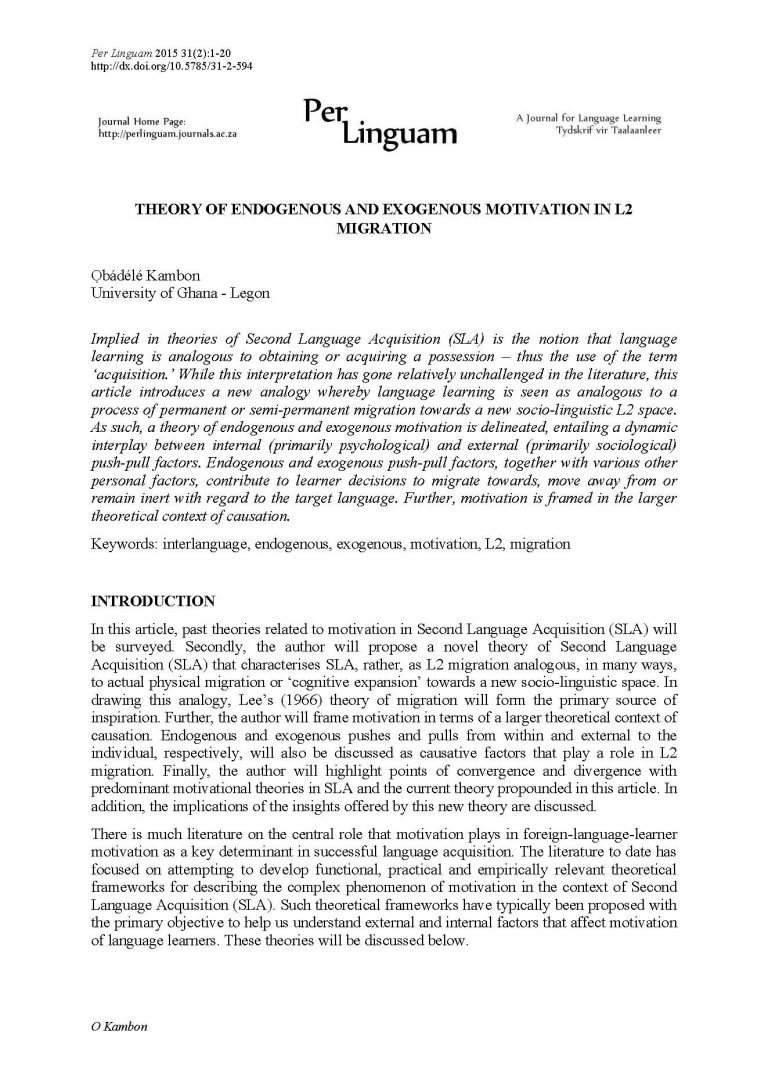
Kambon, O. (2015). Theory of Endogenous and Exogenous Motivation in L2 Migration. Per Linguam, 31(2), 1-20.

Theory of Endogenous and Exogenous Motivation in L2 Migration

Kambon, Ọ

Per Linguam, 31(2), 1-20

Abstract, significance and citation data

Abstract Implied in theories of Second Language Acquisition (SLA) is the notion that language learning is analogous to obtaining or acquiring a possession – thus the use of the term ‘acquisition.’ While this interpretation has gone relatively unchallenged in the literature, this article introduces a new analogy whereby language learning is seen as analogous to a process of permanent or semi-permanent migration towards a new socio-linguistic L2 space. As such, a theory of endogenous and exogenous motivation is delineated, entailing a dynamic interplay between internal (primarily psychological) and external (primarily sociological) push-pull factors. Endogenous and exogenous push-pull factors, together with various other personal factors, contribute to learner decisions to migrate towards, move away from or remain inert with regard to…

Serial Verb Nominalization in Akan
2012 Thesis

Serial Verb Nominalization in Akan

Ọbádélé Bakari Kambon

Kambon, Ọ. (2012). Serial Verb Nominalization in Akan. (PhD). University of Ghana, Legon.

Abstract, significance and citation data

This thesis focuses on nominalization of serial verb constructions (SVCs) in the Akan language. The study develops a relevant typology of serial verb nominalization on the basis of semantic integration and lexicalization using a prototype theory (PT) framework. The three degrees of semantic integration for serial verbs in Akan are Full Lexicalized-Integrated Serial Verb Constructions (FL-ISVCs), Partial Lexicalized-Integrated Serial Verb Constructions (PL-ISVCs) and Clause Chaining Serial Constructions (CCs or CSCs). Each type of SVC is analyzed on the basis of how it is nominalized, the degree to which nominalization occurs and whether nominalization can occur at all. Various corpuses were consulted in three major literary dialects of Akan: Asante Twi, Fante and Akuapem Twi. Further, native speakers of each of…

Recurrent Sound Correspondences of Akan and Yoruba and their Significance for Proto-Benue-Kwa (East Volta-Congo) C1 Reconstruction
2005 Thesis

Recurrent Sound Correspondences of Akan and Yoruba and their Significance for Proto-Benue-Kwa (East Volta-Congo) C1 Reconstruction

Ọbádélé Bakari Kambon

Kambon, O. (2005). Recurrent Sound Correspondences of Akan and Yoruba and their Significance for Proto-Benue-Kwa (East Volta-Congo) C1 Reconstruction. (Masters Thesis). University of Wisconsin-Madison, Madison, Wisconsin.

Abstract, significance and citation data

Abstract This thesis will address the implications of lexical cognates and regular sound correspondences in the basic vocabulary of Akan (Twi) and Yoruba. Reconstruction, a central focus of comparative linguistics, is based upon determining regular sound correspondences between two languages that are already presumed to be related. By applying the comparative method and implicational laws of sound change to data derived from the first and second Swadesh Lists, the phonological inventory of the proto-language, Proto-Benue-Kwa (East Volta-Congo), from which Akan (Twi) and Yoruba are descended, will be juxtaposed with current reconstructions, primarily as pertaining to the initial consonant (C1). These recurrent phonological correspondences will serve to bring us closer to a true reconstruction of Proto-Benue-Kwa (East Volta-Congo) in essentially the…

BibTeX

https://ling.auf.net/lingbuzz/002769

The wider archive

Follow the work
across disciplines.


×