A Satirical Photo Essay by Ɔbenfo Ọbádélé Bakari Kambon
It began in the basement of a university library, where a graduate student—fueled by caffeine and dread engendered by “imposter’s syndrome”—stumbled across the 19th-century blueprints for what administrators would later call “Selective Blindness.”
In the yellowed pages of Champollion-Figeac’s Égypte ancienne (1839), the student found a logic-defying intellectual gymnastics routine:
“…the Egyptians had black skin and woolly hair. Yet these two physical qualities do not suffice to characterize the Negro race… [the conclusion] is evidently forced and inadmissible.”
This was followed by Samuel George Morton’s 1844 clarification in Crania Ægyptiaca:
“Negroes were numerous in Egypt, but their social position in ancient times was the same as it now is, that of servants and slaves.”
The premise was clear: Concede the skin. Concede the hair. Concede the numbers. But deny the identity. Within hours, the screenshots went viral. Public trust plummeted. A congressional subcommittee, panicked by the sudden visibility of this historical gaslighting, proposed a solution as absurd as the problem: A Cross-Disciplinary Perception Pilot Program.
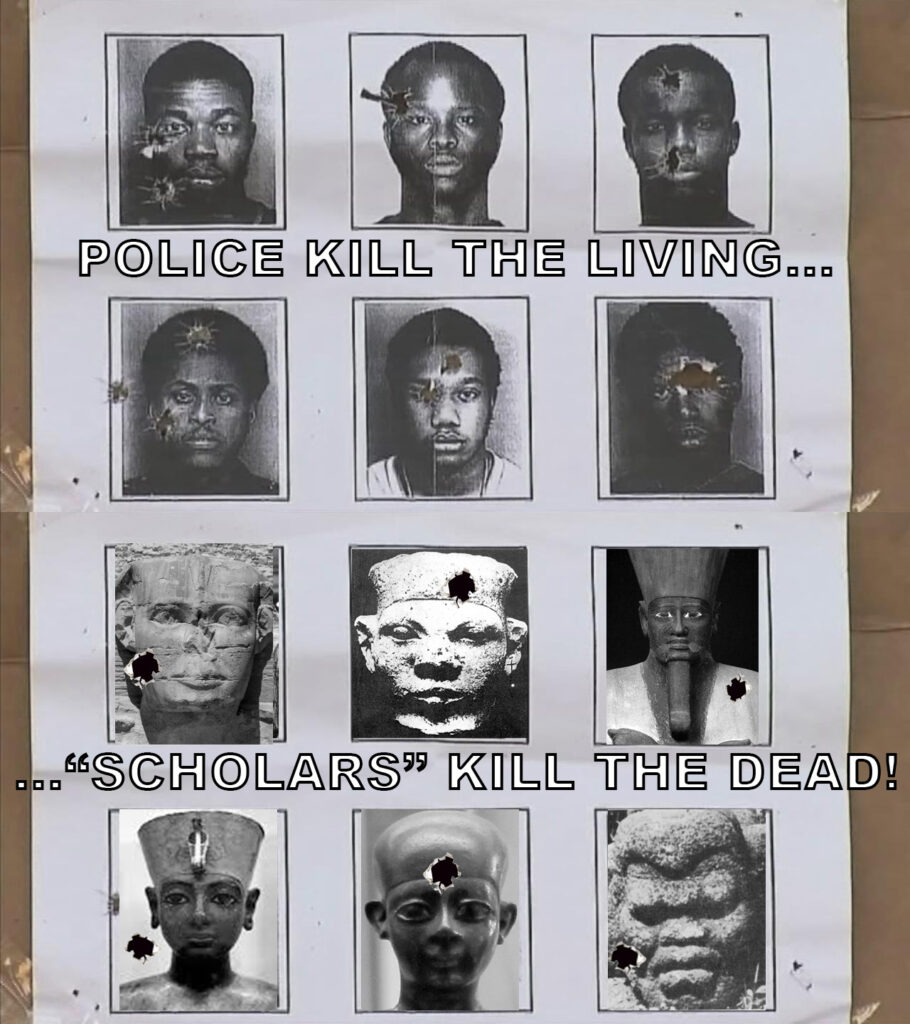
Managed by the newly formed Department of Historical Realignment (DHR), the strategy was simple: Egyptologists and U.S. Police Officers would switch jobs. If scholars could look at Black skin and decline to call it Black in antiquity, and police could look at Black skin and identify it instantly in the present, the nation’s interpretive inconsistencies would be solved instantly through reassignment.
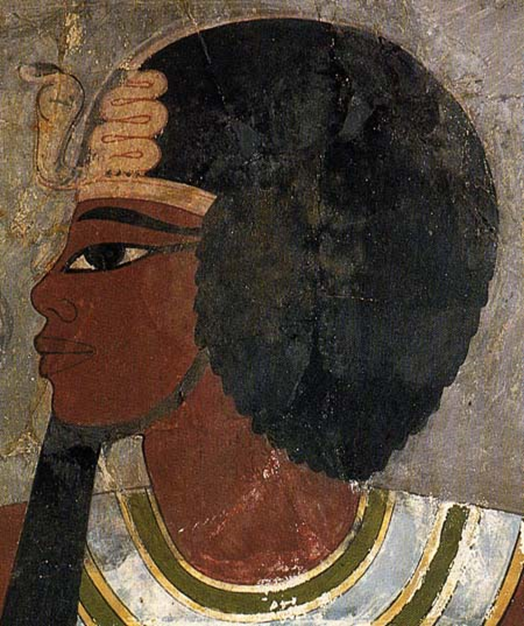
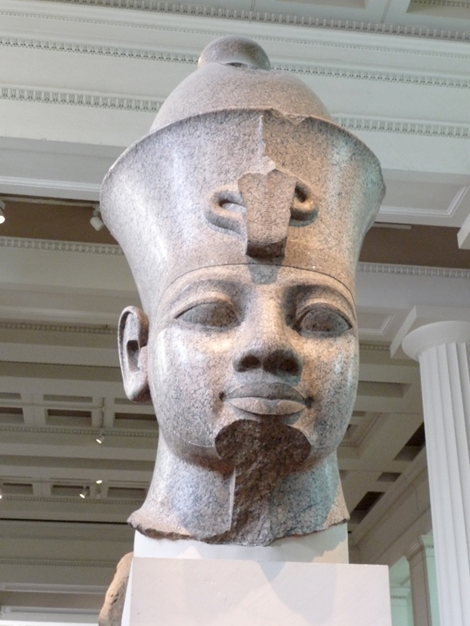
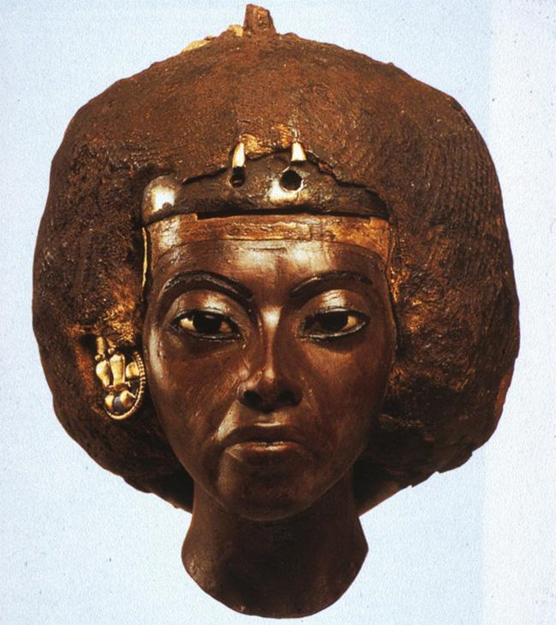
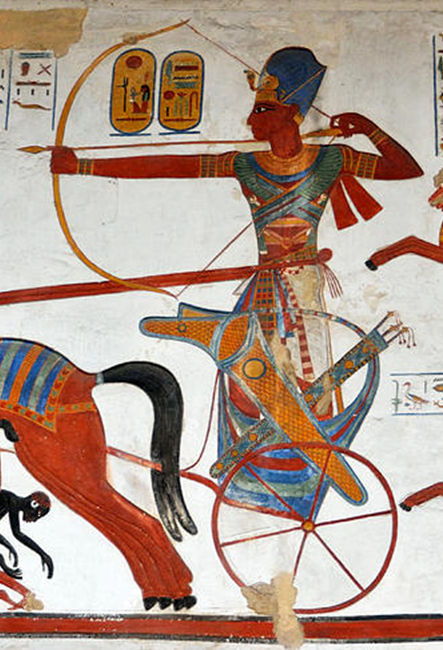
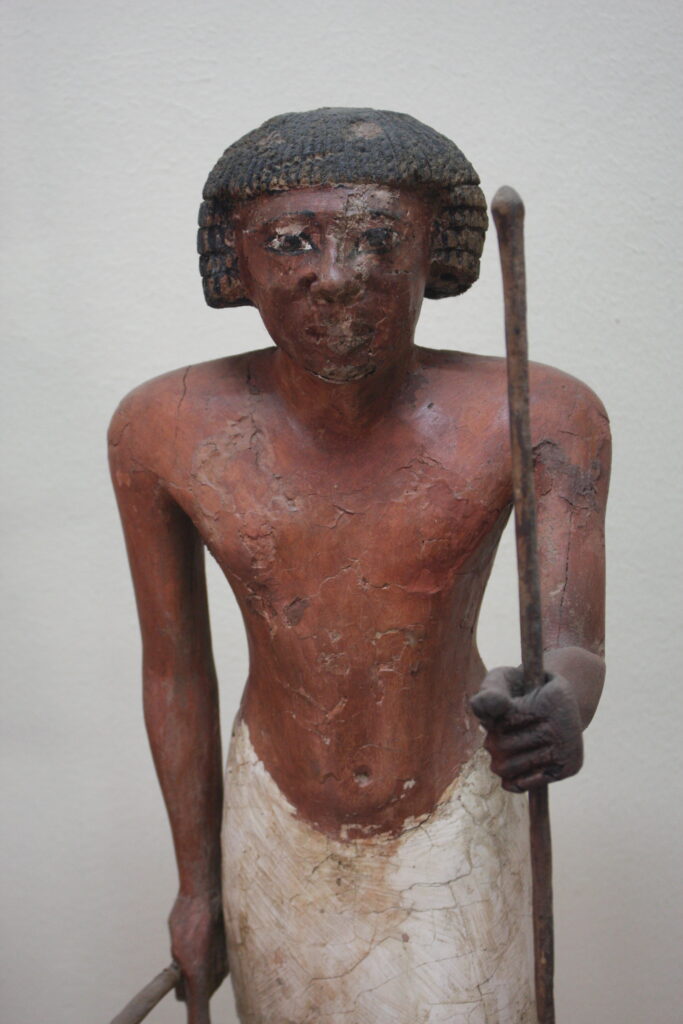
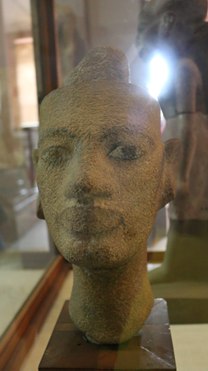
As the newly deputized Egyptologists began their patrols, their training kicked in immediately. Faced with a citizen, they would ponder: despite the deep brown skin or the natural Afro, could this be a “Mediterranean” in disguise? Declaring, “I see no Blackness here!” they let person after person go untouched. The “Stop-and-Frisk” epidemic screeched to a grinding halt. Meanwhile, in the depths of the museums, the relocated police officers looked upon the murals. With a swift glance, they proclaimed, “That’s clearly a Black man!” pointing at statues with broad noses and full lips. Never before had the mysteries of ancient art been solved so quickly.
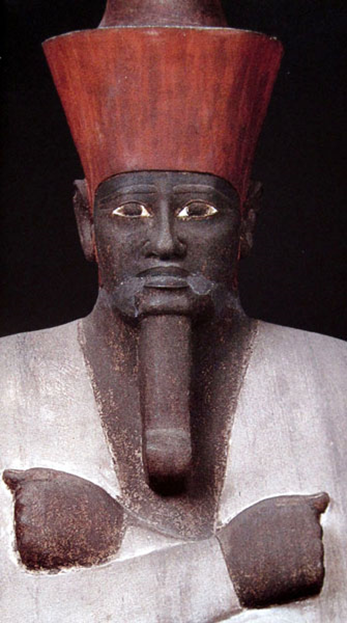
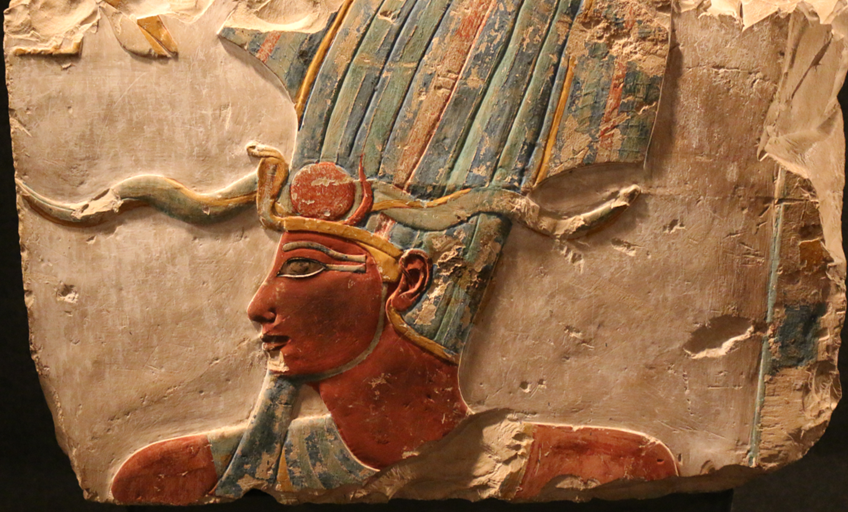
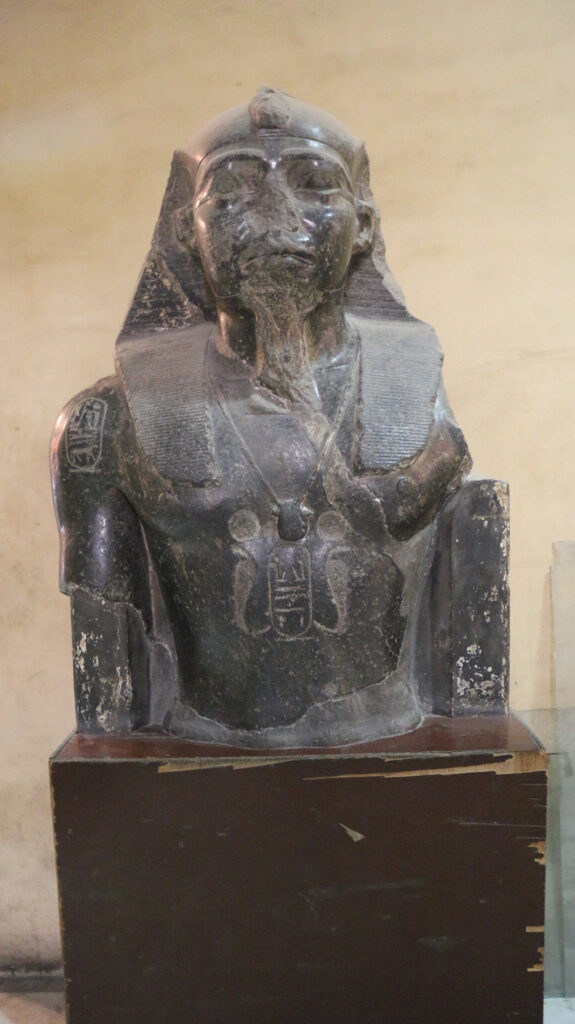
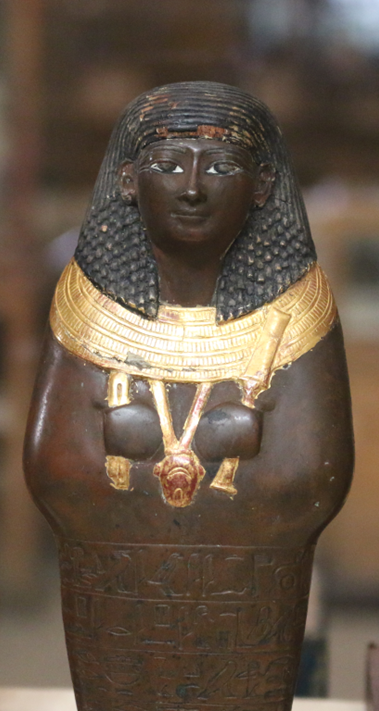
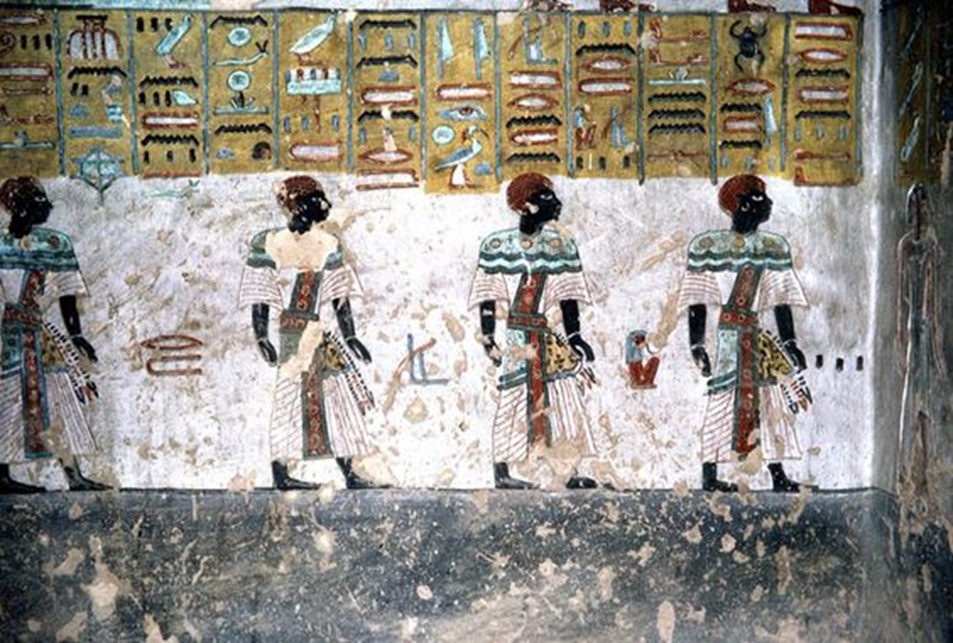
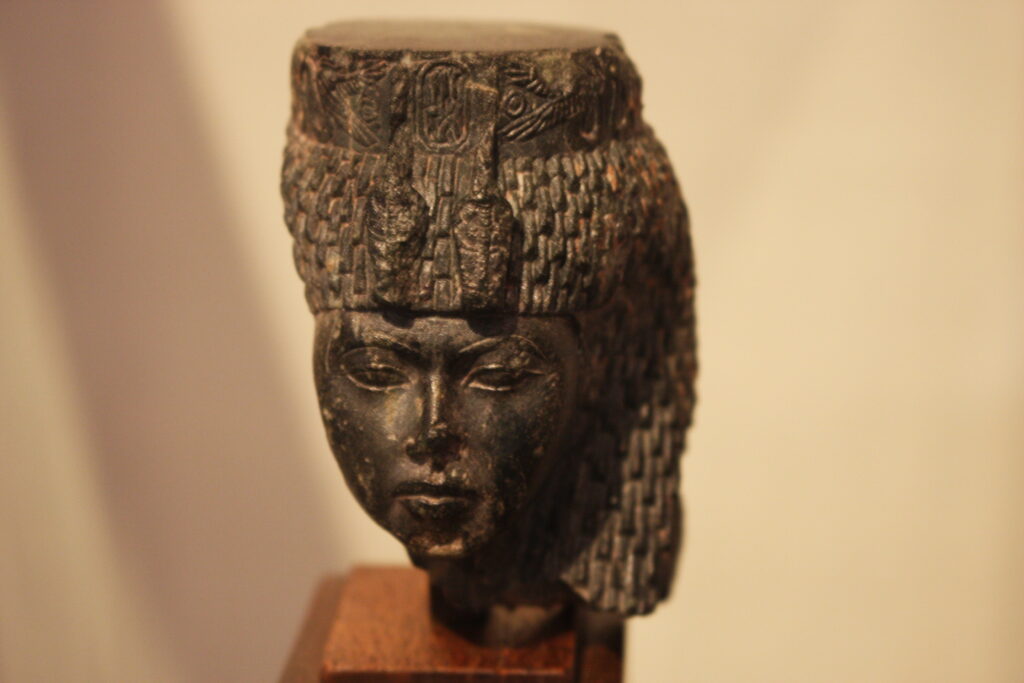
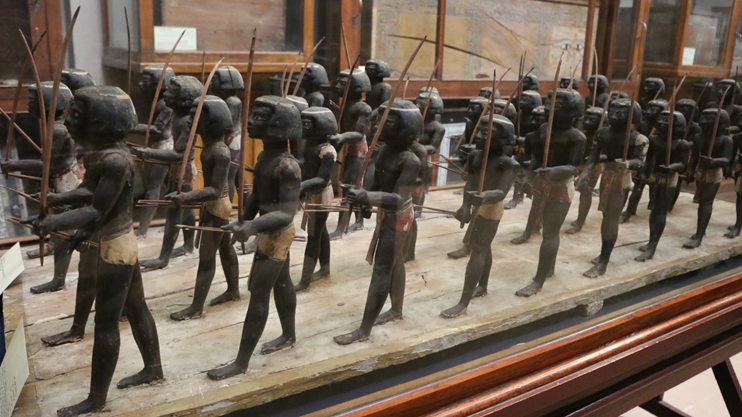
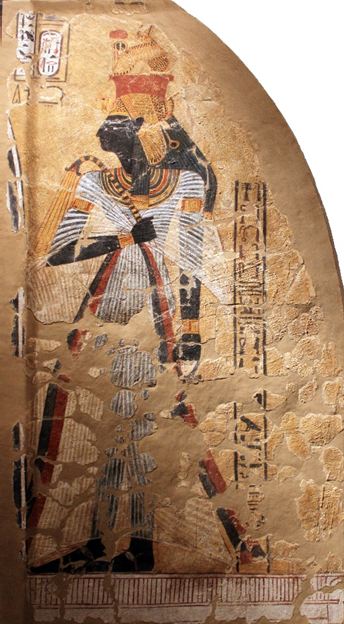
Predictably, the museums were not prepared for the officers’ unusual “field methods.” Several had to be physically restrained — gently, then not-so-gently — after attempting to “secure the scene” by drawing their weapons on a painted procession. One insisted the mural figure was “reaching for something” (a lotus), another tried to place a kneeling offering-bearer in handcuffs for “failure to comply,” and a third raised a billy club before a conservator tackled him mid-swing, shouting, “That’s not a suspect — that’s a statue!” But not before he knocked the beard clean off of the bust in question. By day three, every major collection had instituted mandatory de-escalation protocols, including: no baton within ten feet of antiquities, no “warning shots” in the gallery, and a laminated reminder that “being depicted in profile does not constitute ‘resisting arrest.’”
As this grand experiment unfolded, the consequences became increasingly absurd. Communities reported a sharp decline in incidents of police brutality, as the Egyptologists—ever skeptical—could find no one “Black enough” to warrant any aggression. Simultaneously, archaeological conferences became battlegrounds, with former police officers confidently identifying the Blackness of every pharaoh, leaving traditional scholars flabbergasted. It seemed that when perspectives switched, the truth—or at least the perception of it—was not so elusive after all.
Soon, media outlets began running viral segments. Interviews with perplexed Egyptologists revealed them letting even the darkest-skinned individuals walk away, with scholarly excuses like, “Perhaps they’re just tanned!” “Maybe the Blackness just symbolizes fertility!” Meanwhile, the former officers, now museum docents, prepared lineups of ancient busts, saying, “We’d know these Black folks anywhere.” In this topsy-turvy scenario, the satire was undeniable: perhaps it was never about evidence, but about who held the power to define Blackness all along.
That’s when the social media reels took over with influencers pondering out loud: If scholars could look directly at Black skin and decline to call it Black in antiquity, and police could look directly at Black skin and identify it instantly in the present, perhaps the nation’s interpretive inconsistencies could be solved through making this reassignment…permanent?
I. The Streets: The Great Leniency
The “Egyptologist-Police” were dispatched to the nation’s most heavily policed neighborhoods. The result was a total collapse of the municipal revenue stream.
Accustomed to debating the “Nilotic influences” and “Levantine migrations” of 3,000-year-old mummies, the scholars found themselves physically unable to identify a suspect. In one notable bodycam video, a Professor-Officer pulled over a motorist in Brooklyn:
Officer-Professor: “Sir, while your phenotype suggests a West African origin, your cranial structure possesses a certain ‘Homeric’ dignity. I suspect you are actually an Anatolian migrant with a heavy sun-tan from agricultural labor. Please, go home and read more Herodotus.”
Crime rates didn’t just drop; they evaporated. The Egyptologists were too busy writing 40-page dissertations on the suspects’ supposed Caucasian ancestral DNA to ever reach for their handcuffs. They saw “Sun-Kissed Semites” and “Nubian-Adjacent Caucasians” where there were once only “suspects.”
II. The Museums: The “Field Methods” of History
Meanwhile, the “Officer-Egyptologists” were handed white gloves and sent to the Metropolitan Museum of Art. They did not share the scholars’ hesitation. In forty-eight hours, they “solved” three millennia of history.
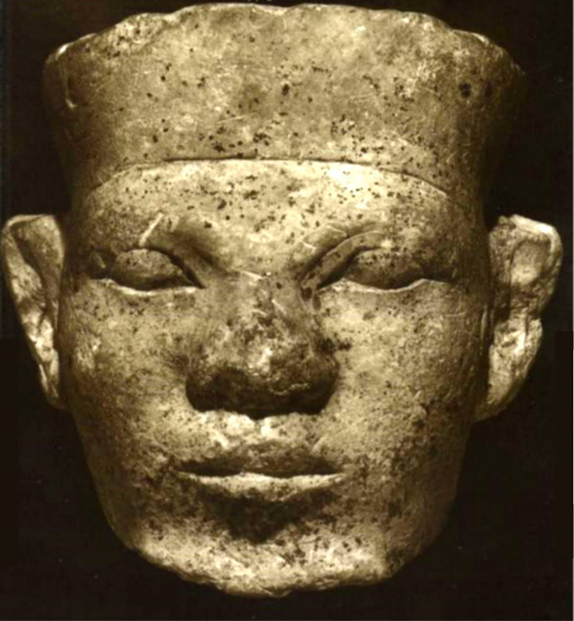
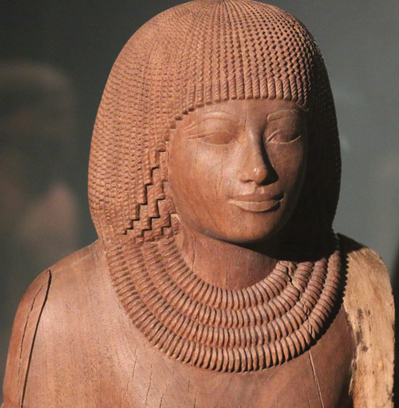
“I know that guy,” Sergeant T. Kowalski remarked, pointing at a 12th-Dynasty bust. “I’ve seen him on 4th and Main every Friday night. That’s a Black man, age 20 to 30, likely a leader of a local organization. Why is the tag saying ‘Eurasian Influence’?”
However, the transition was not without “procedural escalations”:
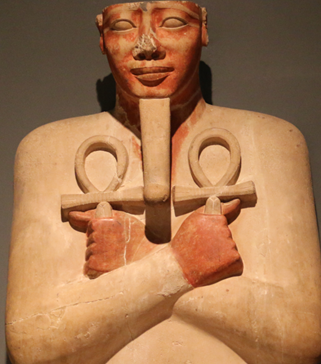
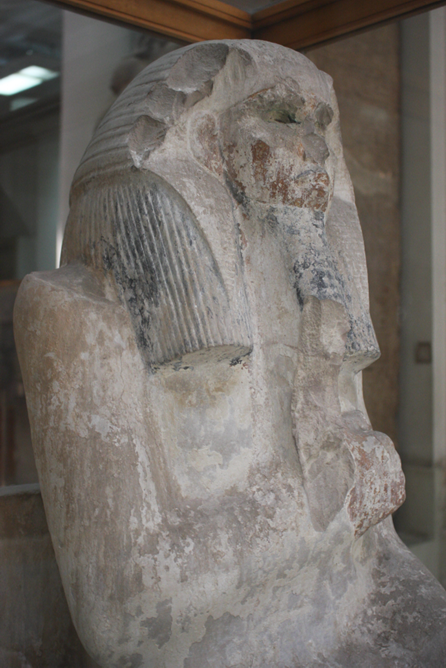
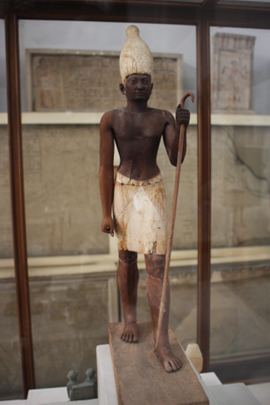
The Djoser Incident: Officer “Sully” Sullivan sheared the nose off a limestone statue of Pharaoh Djoser after the subject failed to produce ID and exhibited “extreme non-compliance” by staring eternally into the afterlife.
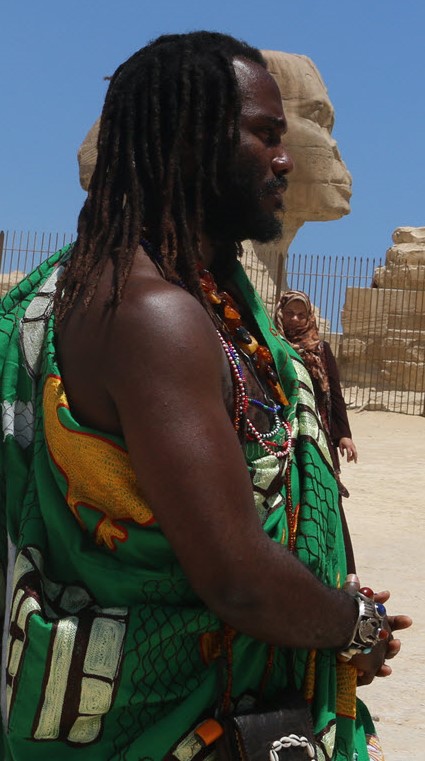
The Sphinx Engagement: A SWAT team lead authorized a .50 caliber “warning shot” to the nose of the Great Sphinx, claiming he saw a “glint of light” in its eye and interpreted the 241-foot monument as a “fortified sniper nest.”
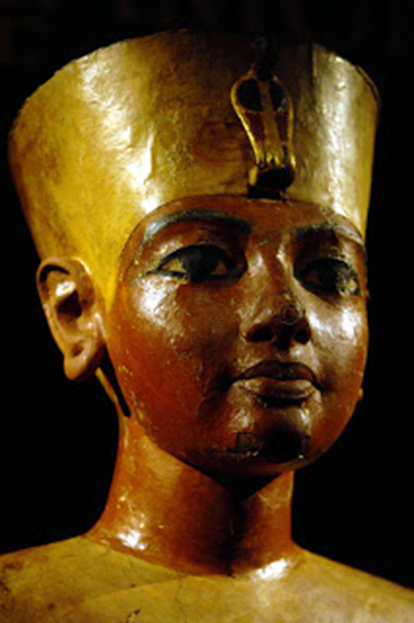
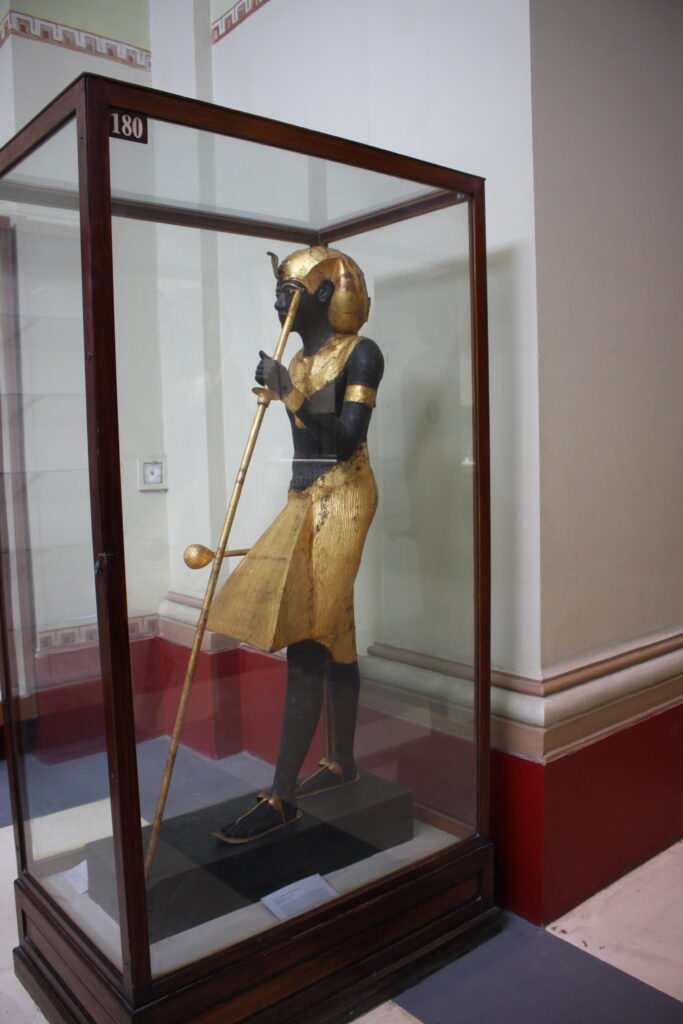
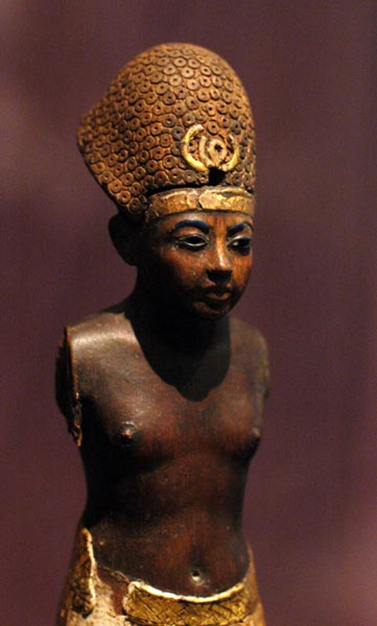
The Tutankhamun Frisk: A sergeant was placed on administrative leave after attempting to taser the Golden Mask of Tutankhamun. He claimed the “crook and flail” were “gang-affiliated weaponry” and that the subject’s eyeliner was a “deliberate attempt to evade facial recognition.”
III. The Trial of the Century
The experiment reached its peak in a D.C. Federal Court, where Detective Marcus Thorne—now a “Consultant on Ancient Phenotypes”—testified against a panel of traditional scholars.
Prosecutor: “Detective, you claim this 18th-Dynasty mural depicts a Black man. But the ‘Hamitic Hypothesis’ states—”
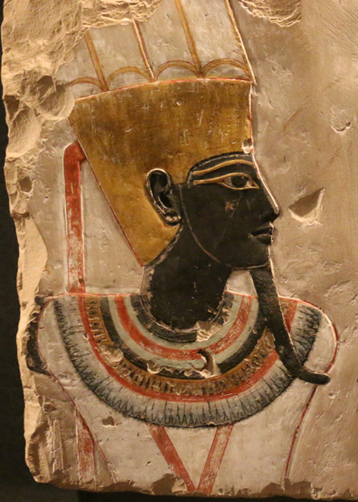
Thorne: “Doc, I’ve spent twenty years identifying suspects in low-light conditions. I know a Black man when I see one. You’re telling me he’s ‘Mediterranean’? If I saw him in a hoodie at midnight, I’m calling for backup. Why is he ‘Sub-Saharan’ when he’s in the back of my cruiser, but ‘Eurasiatic’ when he’s in a display case?”
The courtroom went silent. The Egyptologists in the gallery began frantically citing texts from 1839, while the former police officers in the back row simply nodded, whispered, and noted that the Pharaoh “matched the description” of every person they had ever stopped in Bed-Stuy.
IV. Conclusion: The Termination of Truth
The DHR officially terminated the program last week. The final report was a sobering indictment of “Professional Eyesight (or lack thereof)”:
“We found that everyone can see the truth, provided they are not being paid to ignore it.”
The Legacy
By the end of the year, the Department of Historical Realignment quietly declared the experiment a success and made the arrangement permanent.
That is not to say that the museums had not experienced several “operational incidents.” They certainly did. Indeed, one officer had to be restrained while shouting that a granite statue was “resisting arrest.” Another attempted to subdue a wall relief with a billy club before conservators intervened. A third had to be escorted out of a gallery after insisting a mural figure was “reaching for something” and attempting to put several “warning shots” into a 3,000-year-old painting.
Meanwhile, the Egyptologist patrol units had their own complications. Several had to be reminded that a routine noise complaint was not an excuse to convene an impromptu panel on a phantom Caucasian race that supposedly built pyramids they didn’t have in their own homeland only to vanish immediately after.
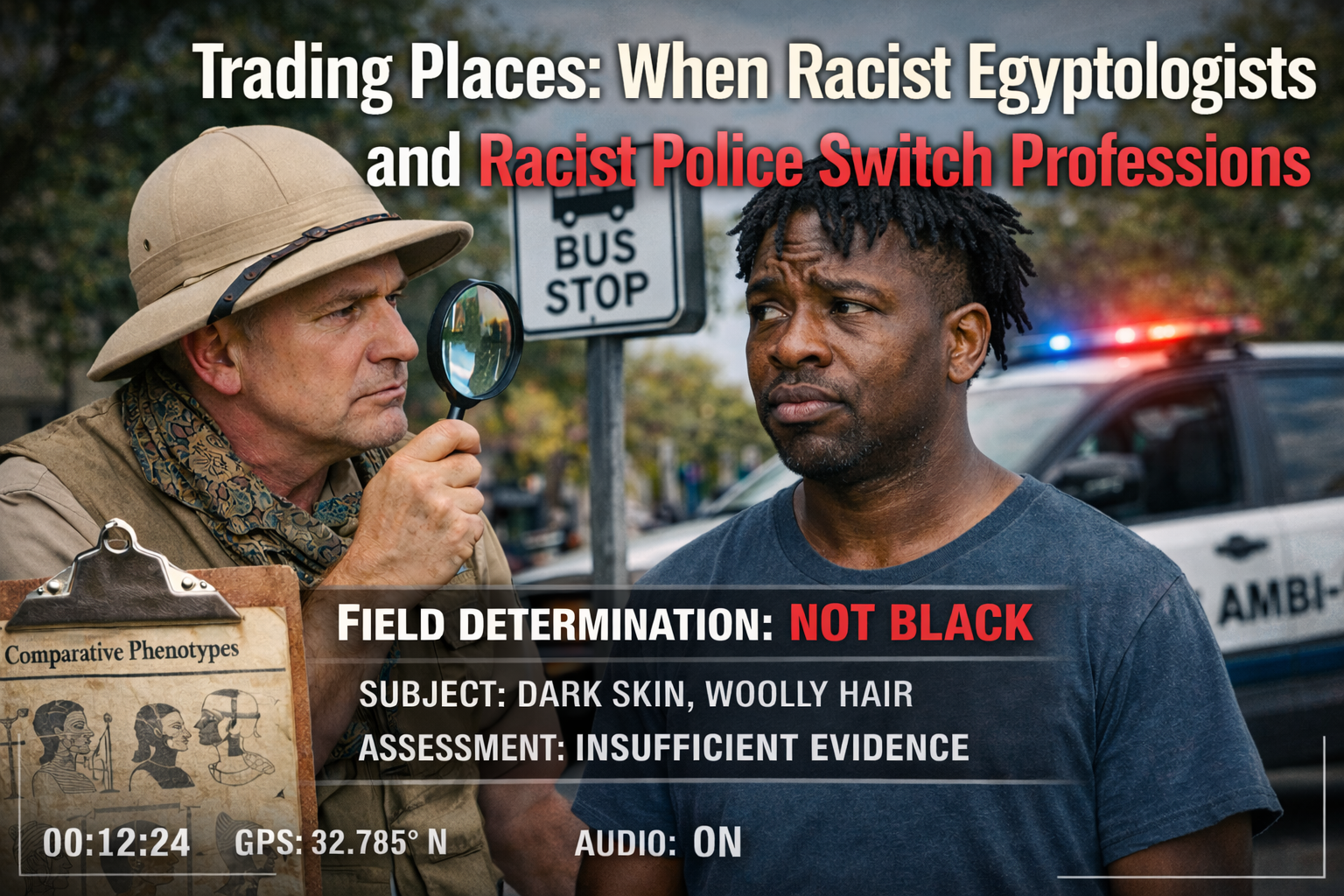
Body-cam footage soon went viral of one officer stopping a man at a bus stop and conducting what he called a “field classification.” Circling him slowly like a museum curator examining a newly acquired artifact, he narrated into the camera with clinical authority: “Yes, the subject clearly possesses dark skin… and the hair is indeed woolly. These features are noted. However—” he paused, leaning in as though inspecting a chipped inscription, “—these characteristics alone are not sufficient to categorize the individual as Black.” After several more rotations and a brief consultation with a laminated chart titled Mediterranean Variants and Related Populations, the officer sighed, pulled out a citation pad, and handed the bewildered commuter a slip that read:
FIELD DETERMINATION:NOT BLACK NOTES: Dark skin and woolly hair observed; insufficient for classification as Black. DISPOSITION: Reassigned to “Mediterranean-adjacent / indeterminate” category. ACTION: No further contact warranted. REFERENCE: See Champollion-Figeac’s Égypte ancienne (1839)
This wasn’t a one-off incident. No! Whenever they encountered an unmistakably Black person—deep Black complexion, tightly coiled hair, broad features—their training activated like a reflex. They would concede the Blackness of the skin and the kinkiness of the hair. But at the end of the day, the individual would be reclassified on the spot as “Levantine-adjacent,” “Nilotic-influenced,” “South Mediterranean,” “pre-Islamic Berber continuum,” or, in one celebrated case, “a highly tanned person of indeterminate Eurasian origin.”
And that is when the municipality’s mood turned sour: citations dropped, arrests collapsed, court dockets emptied, and revenue projections fell off a cliff—because an entire ecosystem had quietly been living off the reliable identification and processing of Black people. Bail bondsmen, prosecutors, judges, defense attorneys, private prison contractors, wardens, and probation officers all found themselves, suddenly, “underfunded,” “restructured,” and “out of a job,” as the customary fodder for cages became, by scholarly decree, something else entirely and therefore—administratively speaking—no longer admissible.
The nation adjusted—slowly, painfully. Municipal budgets began to wither. Court dockets dried up. Entire ecosystems—that were effectively welfare for “whites” too incompetent to get a real job—that had parasitically lived off processing Black people found themselves starving for arrests to kickstart the machinery. What had been sold as a “justice system” revealed itself, in practice, as a labor-and-revenue pipeline—one that only functioned efficiently when Blackness was reliably identified, criminalized, and converted into fees, fines, contracts, and “bed counts.” And hanging over the whole collapse was the constitutional language that had made the arrangement “respectable” in the first place:
“Neither slavery nor involuntary servitude, except as a punishment for crime whereof the party shall have been duly convicted, shall exist within the United States, or any place subject to their jurisdiction.”
With the habitual identification-and-arrest machine suddenly jammed by scholarly “inadmissibility,” the country was forced into a drawn-out reckoning with the fact that the exception caveat had never been a historical footnote—it had been the operating system to keep Black people working for free in a state as close to enslavement as possible.
Meanwhile, museums became places where Blackness in antiquity was identified with the blunt certainty of a police lineup. The streets became places where Blackness in the present was examined with the endless hesitation of an Egyptology seminar.
And in the strange clarity produced by this exchange of uniforms, one uncomfortable fact became impossible to ignore:
In the end, the police could identify the statues immediately, the Egyptologists could not identify the people standing in front of them, and the statues themselves remained exactly what they had always been: Black.
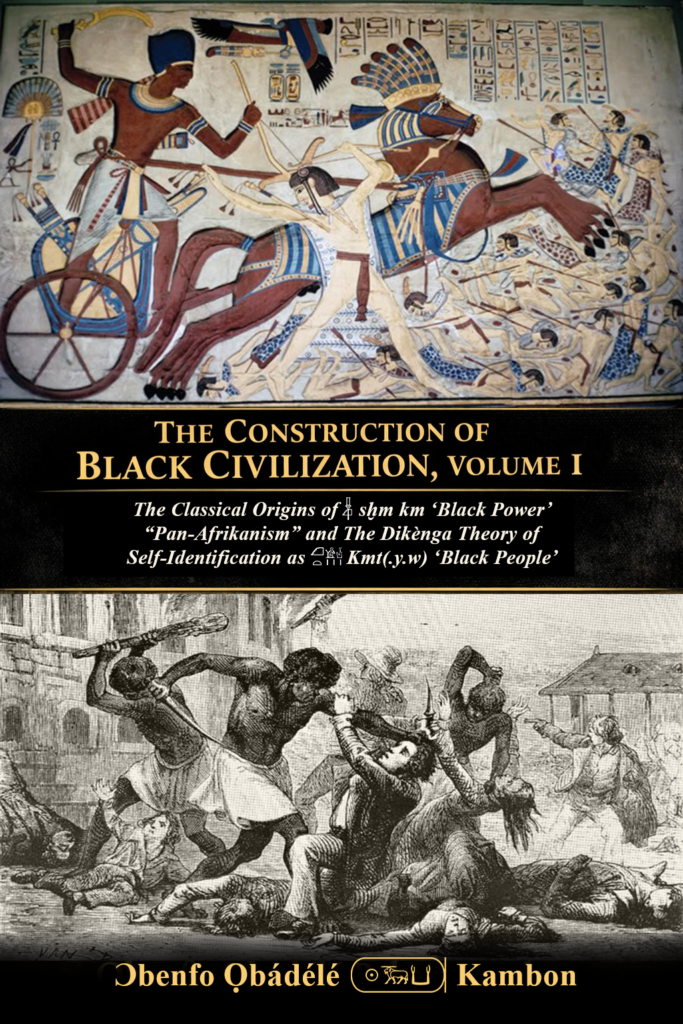
For readers who would like the non-satirical version of this discussion, the historical evidence itself will be examined in detail in my forthcoming book, The Construction of Black Civilization, where the question of how and why this “Hidden-in-Plain-Sight Problem” emerged is addressed not with satire, but with sources.
Ways to pre-order coming soon!
Tag: Trading Places: When Racist Egyptologists and Racist Police Switch Professions