

$20.00
Description
Pan-Afrikanism is often regarded as a modern phenomenon and a direct response and/or reaction to enslavement and colonisation. Black(ness), as an identity encompassing genotype, phenotype, allegiance, individual and collective behavior (culture), and politics, is also similarly seen as a modern-day phenomenon and a response to whiteness as developed subsequent to Bacon’s rebellion and/or as a result of the rise of capitalism and subsequent justifications for enslavement.[1] However, Black Pan-Afrikanism can be understood as the development of Afrikan=Black power in the interests of self-preservation and the survival of Afrikan=Black people.[2] In both classical times and modern times, one means to these ends has manifested in the unification of Kmt(yw) ‘Black people’ and Kmt ‘The Black Nation/Land of the Blacks’. As such, we argue that the concept, theory, and practice of the unification of Afrikan=Black people along political, economic, military, and other lines is a demonstrably ancient imperative of Black people. Through this lens, we further argue that instances of original authentic Black Pan-Afrikanism in practice can be observed in all ancient and modern Afrikan nations, which unified various smaller Afrikan countries and the Black people therein into progressively larger states and nations.[3] Most notably, this imperative can be seen in Ancient Kmt ‘The Black Nation/Land of the Blacks’ which, through smз tзwy ‘unification of the two lands,’ unified šmˁw ‘Upper Kmt’ and Tз-mḥw ‘Lower Kmt’ and the Kmt(yw) ‘Black People’ located therein geo-politically, militarily, economically, spiritually, and socially. This article presents primary source texts from Kmt ‘The Black Nation/Land of the Blacks’ that demonstrate the reality of this phenomenon. Secondarily, we present evaluative criteria by which each text can be examined. We find that these texts exude a clear consciousness of the Kmt(yw) ‘Black People’s’ self-identification as Black as well as a clear and consistent opposition to non-Black aAm.w ‘eurasians’ both in the interest of the survival of Kmt(yw) ‘Black People’. This consciousness is analyzed in analogy with anti-predator adaptation theory in terms of convergent (social) evolution whereby people and creatures who intend on surviving come together on the basis of what they have in common fundamentally—common ancestry and descent—often readily distinguishable through distinct phenotypes.
97 Slides
72 minutes
Keywords: Pan-Afrikan Nationalism, Pan-Afrikanism, Kmt(yw), origins, Black
[1] Terrance MacMullan, Habits of Whiteness: A Pragmatist Reconstruction (Bloomington, IN: Indiana University Press, 2009).
[2] This equation of Afrikan=Black is used in throughout this work as a proxy to approximate the connotation of Kmt ‘The Black Nation/Land of the Blacks’ which links the land of the continent now referred to as “Africa” as well as the Blackness of the indigenes of this land. This becomes unnecessary in recourse to any indigenous language whereby the two are linked, such as Kmt ‘The Black Nation/Land of the Blacks’ and Kmt(yw) ‘Black People.’ It is also used due to the confusion that comes with the inclusion of “settler,” ɛ.n. intruder, eurasians (indians, arabs, europeans and, soon, chinese) under the term “African,” we use the formula “AFRIKAN=BLACK” to clarify that for us the terms “Afrikan” and “Black (people)” are synonymous.
[3]See Nathan Goldberg, “Ture Exhorts Audience to Organize to Effect Social Change,” UB Reporter 26 (1995), http://www.buffalo.edu/ubreporter/archive/vol26/vol26n16/6.txt. “A central point of Ture’s lecture was that Africa would be the first continent to unify under one socialist government. This unification, he maintained, would already exist today had Africa’s natural evolutionary process toward unity not been interrupted by European colonialism and the slave trade.” This is a different point from the one being made in this paper as we are arguing that models of Pan-Afrikanism in practice existed in Classical Afrika rather than it was on the verge of being implemented at the dawn of eurasian imperial onslaught against Afrika and the consequent periods and practices of colonialism and enslavement of Afrikan societies and people. For our purposes, ancient/classical can be understood on the scale of thousands of years ago, while modern can be understood on the scale of hundreds of years ago up to contemporary times.
Related products
-
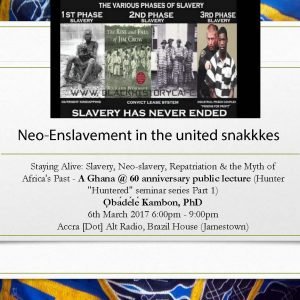
Staying Alive: Slavery, Neo-Slavery, Repatriation & The Myth Of Africa’s Past
$20.00 Add to cart -
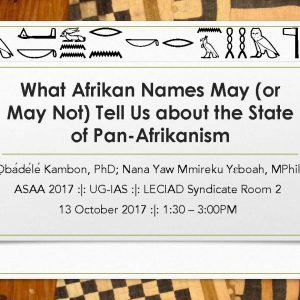
What Afrikan Names May (or May Not) Tell Us about the State of Pan-Afrikanism
$20.00 Add to cart -

“Afrikan Lives Matter and Decolonizing the Academy”
$20.00 Add to cart -

Writing in Akan: Misspellings, Typos, Deviations or Innovations?
$20.00 Add to cart
Leave a Reply